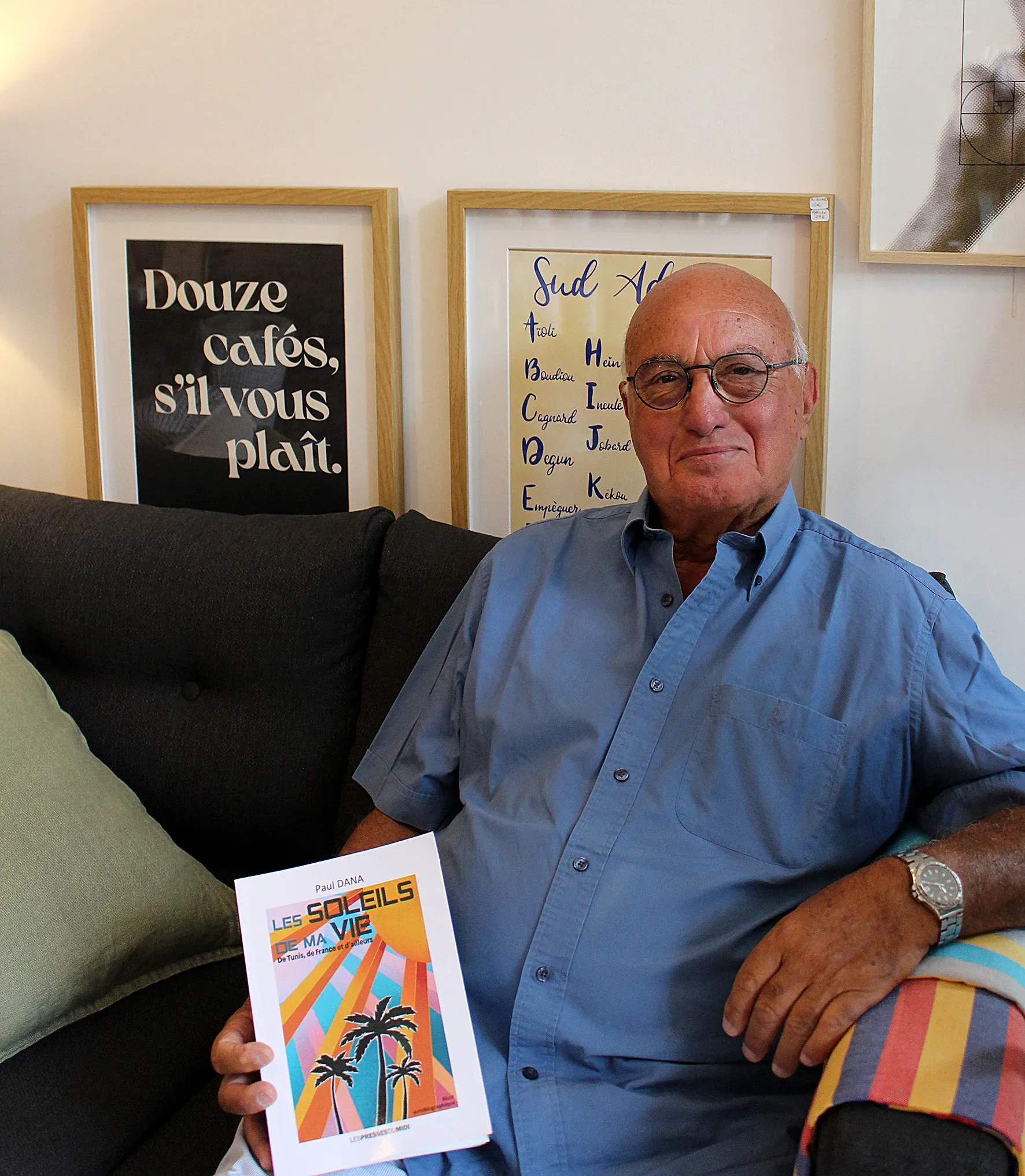
Paul Dana answers questions from La Gazette du Var.
Why this autobiographical account?
I asked myself questions about the meaning of life, the swiftness of existence. I wanted to leave a trace for my daughter and my two granddaughters of what my life was, our life, because with my wife, we lived practically half a century together, which leaves memories and imprints. I had this desire for transmission. So, I started writing. It took me about a year and a half to write it. As I am a bit of a perfectionist, I was looking for the right word, the right formulation, avoiding repetitions.

Avec le désir de laisser une trace ?J’ai eu une enfance et une adolescence très heureuses. Ma famille a joué un rôle essentiel. J’étais entouré de personnes optimistes, qui aimaient la vie. Dans la première partie du livre « L’enfance et l’adolescence à Tunis », je passe en revue tous mes oncles et tantes, mes cousins, mes grands-parents. Je décris l’ensemble de ma famille pour insister sur la transmission naturelle de l’ensemble des gènes. Au-delà de ça, j’ai goûté la bonne chair, les bons plats, la cuisine. Mes grands-mères, mes tantes et ma mère cuisinaient très bien, c’était toujours très festif. Je suis un épicurien, un amoureux de la vie.
With a joyful and studious adolescence?
Advertisement
Indeed, I started my studies at the high school in Tunis, then my secondary education in technical studies, in the suburbs of Tunis. In my book, I took pleasure in telling funny anecdotes about those years.
Do you have any anecdotes to share?
With pleasure! Since the sports fields were not yet built, it was the students who, during physical education classes, carted wheelbarrows of soil to build the fields. Every summer, my family and I went on holiday to the coast near the sea, so we had to bring everything, mattresses, kitchen utensils, aided by movers using horse-drawn carts, like in the good old days of the Far-West, before the later arrival of trucks which made children dream less. I spent fantastic summers with friends and of Carthage. We also played in a large hotel in Tunis. My grandmother had passed down to me a magnificent piano on which I played by ear long before.
Your arrival in France... at 20 years old with goals in mind?
I arrived in France, in Paris, in August 1964. My parents joined me two months later. I had to find a job. I had precise goals back then: to bounce back and build, to evolve, to blossom. First, I joined a company as an industrial draftsman. I only stayed there for 15 days because the company was facing management problems. I quickly found another position as a technical agent. But this world was hostile and unknown to me, people did not match to choose the curriculum 'Organisation du travail et des entreprises'. I met exceptional teachers. For one year, I was an assistant to one of them. I read the books, summarized them, and presented them to the students.
What a rich experience!
I also had Michel Rocard as a teacher. I obtained my final degree in 1973. I stayed 20 years at Massey-Fergusson, held about 10 different positions, and was able to carry out five studies of organization, improvement, and resolution of dysfunctions. I became an expert in the study of complex and transversal processes.
You had a very rich professional life?
Advertisement
Indeed, during my professional career, I occupied various positions in meeting wonderful people both personally and professionally.
Then, a difficult early retirement?
Yes, I found myself between 4 walls. To overcome this lack of activity and communication, my decision was to put on paper everything I had undertaken that was 'good' in my professional career to distribute it as information to companies and their employees. I thus created a collection in which I offer advice, solutions on management as well as on people management.
Finally, an encounter with the Sud de la France?
I met my wife, Hélène, in Paris, in 1966. She later came to settle in Toulon. I came to visit her regularly. My daughter, Chantal, was born in 1976. After some adventures and a second home in Andalousie, we unpacked our bags, in 2005, in Hyères. In 2018, my wife, Hélène, fell ill. She passed away, alas, some time later, leaving me in total disarray. Always with this drive to bounce back despite the circumstances, I decided to reconnect with life, meeting wonderful people, notably with my golf club, the jazz festival, as well as other cultural and oh so enriching events.
In the end, with writing as therapy?
Thanks to my optimism and my desire for resilience which never left me, I did not sink. Indeed, writing my book was also a true therapy. I started the work in late 2021, early 2022. What a pleasure to relive all these years... to be able to leave a real footprint. I submitted the manuscript in the summer of 2023 and the book was published in March 2024, giving me the immense joy of seeing such a project succeed.
Paul Dana 'Les soleils de ma vie' published by 'Les Presses du Midi' www.lespressesdumidi.com We extend special thanks to Chantal (Le T’Zébré) who welcomed La Gazette du Var during this interview.
Interview conducted by Laurette PARAY (Text and photo).