The two worlds of Aloïse and Baya
As part of the exhibition "Dubuffet et les magiciens - Expressions singulières 1945-2000", musée du Niel presents 5 works that reveal...
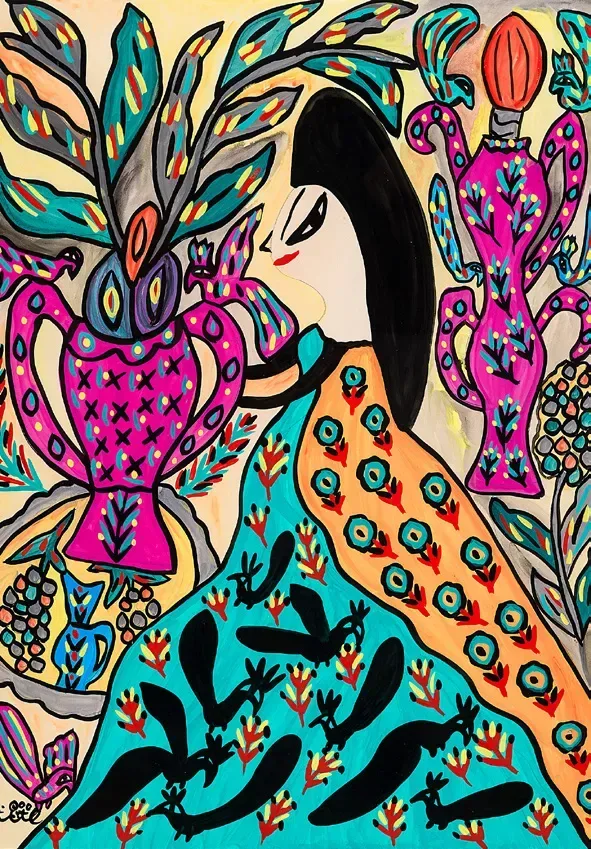
For the two exhibited artists shape their own world, in the form of a personal cosmogony!
These are the two worlds of Aloïse and Baya. Yet, nothing brings them together in their life journeys.
One lives in Suisse, the other in Algérie. One comes from a traditional, white-collar family, the other from a background so modest that it did not give her access to education. One, whom a form of relentless fate always sought to constrain, the other whom luck, a chance meeting, and unpredictable encounters allowed to be emancipated.
Advertisement
The drawn or painted gazes reveal how one, by delivering a theatrical decor, refuses to surrender to the outside world and hides behind the blue mask of her characters; how the other endlessly draws stylized profile eyes rimmed with kohl, extended on the same plane by both the dresses of her characters and the undulating lines of a stylized nature.
SINGULAR ARTISTS By simultaneously discovering the work of these two singular artists, the connection is woven outside of time. Their personality, their spirit, seem to have been forged by the collusion of a double trauma, personal and historical. With the announcement of the war between Prusse and France, Aloïse is forced to give up her job as a governess at the Cour de Guillaume II.
She must leave her dreams of peace behind. Her schizophrenia worsens and they decide to institutionalize her at La Rosière in 1918. She then turns her back on the world of the past, suddenly cut off from all family and social ties.
She experiences her forced confinement as a death. For her part, Baya is confronted with the misery of her native Algérie and the loss of her parents while still a child.
Having become a woman, she would face the war of independence, which was long and of rare violence. From the mud, the ruins of their lives and of the world, they both escape and reign over their pictorial world using only pencils, chalks, or gouache.
In 949, both artists were part of the collection of l'Art Brut of the centre d'art de Lausanne, at the galerie Drouin with more than two hundred works by sixty-three authors. Among them was already Aloïse Corbaz, of whom Dubuffet said: "I believe that the vast tapestry with a thousand panels of Aloïse can be considered the only truly resplendent manifestation, in painting, of the properly feminine pulsation."
As for Baya, although her first meeting with Jean Dubuffet dates back to 1947 in Alger, she would be consecrated thirty years later with a significant donation of her works to the collection Dubuffet: "The works," he said, "are extremely endearing and, for me, highly stimulating.

En découvrant simultanément l’œuvre de ces deux artistes singulières, le lien se tisse hors du temps. Leur personnalité, leur esprit, semblent avoir été forgés par la collusion d’un double traumatisme, personnel et historique. Aloïse est obligée avec l’annonce de la guerre entre la Prusse et la France de renoncer à son travail de gouvernante à la Cour de Guillaume II. Elle doit laisser derrière elle ses rêves de paix. Sa schizophrénie s’aggrave et on décide de l’interner à La Rosière en 1918. Elle tourne alors le dos au monde d’autrefois, coupée soudainement de tous liens familiaux et sociaux. Elle vit son internement forcé comme une mort. De son côté, Baya est confrontée à la misère de son Algérie natale et à la perte de ses parents encore enfant. Devenue femme, elle sera confrontée à la guerre d’indépendance, longue et d’une rare violence. De la boue, des décombres de leur vie et du monde, elles s’évadent l’une et l’autre et règnent sur leur monde pictural juste au moyen de crayons, de craies ou de gouache. En 949, les deux artistes font partie de la collection de l’Art Brut du centre d’art de Lausanne, à la galerie Drouin avec plus de deuxcents travaux de soixante-trois auteurs. Parmi eux déjà Aloïse Corbaz, dont Dubuffet disait : « Je crois que la vaste tapisserie à mille volets d’Aloïse peut être considérée comme la seule manifestation vraiment resplendissante, dans la peinture, de la pulsation proprement féminine ». Quant à Baya, si sa première rencontre avec Jean Dubuffet date de 1947 à Alger, elle sera consacrée trente ans plus tard avec une donation importante de ses œuvres à la collection Dubuffet : « Les oeuvres, dit-il, sont extrêmement attachantes et pour moi très stimulantes. Maintenant je vais les envoyer à Lausanne pour qu’elles prennent place dans la collection de l’Art Brut. Je suis très heureux qu’elles y figurent ».
Now I am going to send them to Lausanne so that they can take their place in the collection de l'Art Brut. I am very happy that they are included there."