“Exceptional men destined for the paths of glory”
On June 6, 1944, a formidable Allied armada attacked fortress Europe by landing on the beaches of Normandy.
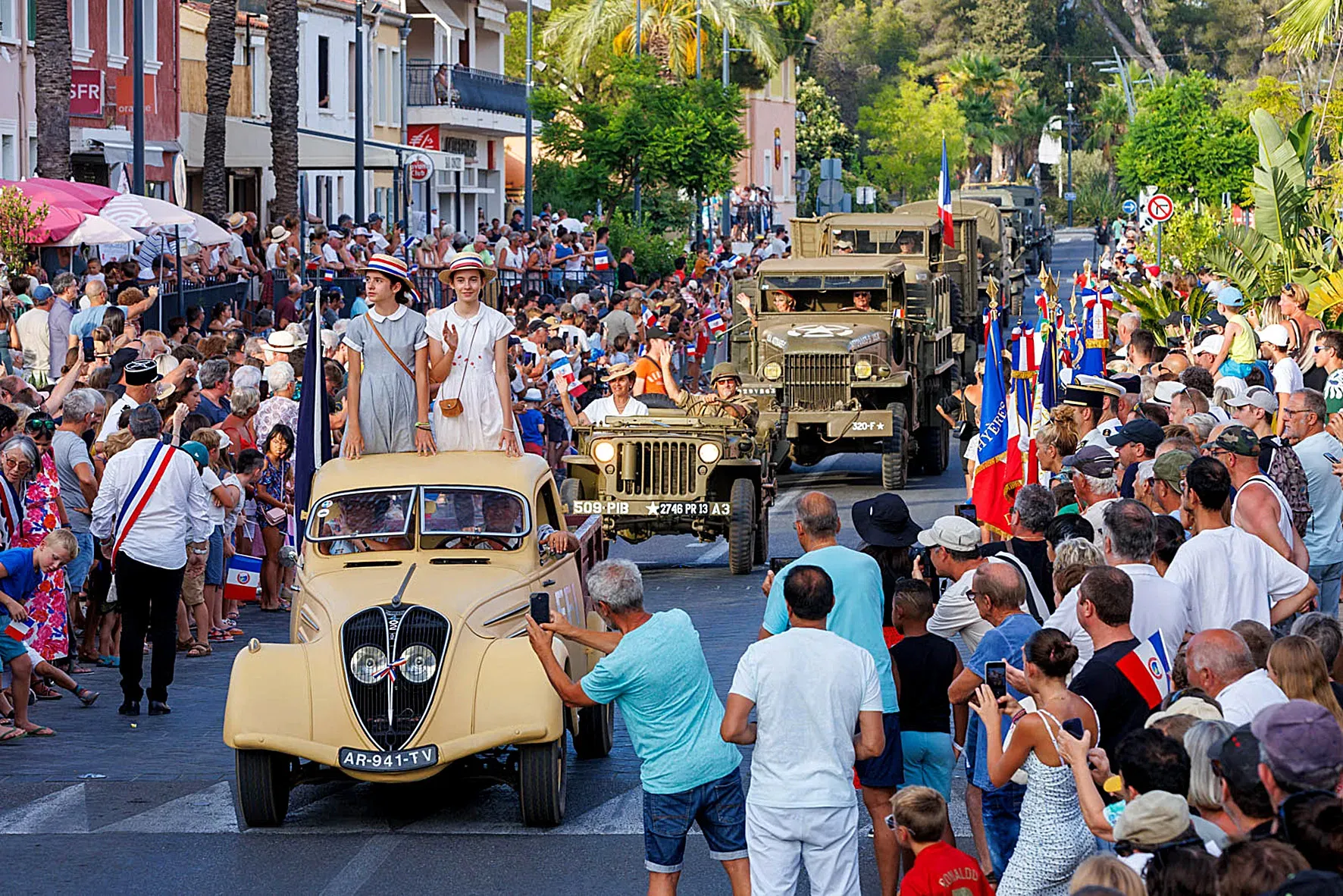
Two months after the Normandy landings, the Allies launched a second landing in France. The scene featured three acts. A landing by both air and sea, the conquest of the ports of Toulon and Marseille, then the advance up the Rhône and the link-up with Patton's army coming from Normandy.
400,000 ALLIED SOLDIERS

This project for a second landing brought together, under the command of General Patch, 400,000 American, British, Canadian, and French soldiers. The latter were the most numerous, with 260,000 men from the French Armée B, the Army of Africa, under the command of General Jean de Lattre de Tassigny. Opposite them, 230,000 German soldiers belonging to Army Group 'G' under General Blaskowitz. For the French Army, this was the long-awaited moment, the hoped-for day of glory. From Tarente, Naples, Oran, and Ajaccio, 800 ships converged on our coasts to form an armada concentrated on the chosen landing points. The day before, Radio Londres broadcast the message for the Resistance: 'The chief is hungry'. The FFI had been waiting for the signal for months. At dawn on August 15, the Allies deployed off the coast of Provence. In the clear, starry night of August 14 to 15, the first elements landed on the Provençal coast. These were mainly the Commandos d’Afrique of Lieutenant-Colonel Georges-Régis Bouvet in the West, at Cap Nègre and Rayol-Canadel. On the morning of August 15, American troops landed on the beaches of Sainte-Maxime, Saint-Tropez, Cavalaire, Pampelonne, and La Croix-Valmer. During the day of August 16 and then August 17, the Garbo force, consisting mainly of French troops from the colonies, landed in turn. The Provence Landings and the freedom regained as of August 15, 1944, bore the colors of the tricolor or the star-spangled banner, and that of the red sail, stamped with the gold star and crescent, of the Commandos d'Afrique.
The history of Provence remains forever linked to the epic journey of this elite unit, the first to liberate it from the occupier. It was these men of incredible caliber, driven by the determination to win as much as by the love of their homeland, who restored France's honor. Everything, from their heroism to their exploits, inspires respect. These exceptional men, who chose the most exposed combat unit, the one with missions deemed impossible, were destined for the paths of glory. And yet, this African troop was very diverse: Pied-Noir volunteers, Spanish, South Africans, Italians, Arabs, Algerians, and Moroccans, soldiers who survived disbanded units, and many young people who had to lie about their age to enlist.

WIND OF FREEDOM
In La Londe-les-Maures, while the vast majority of the population had taken refuge in the countryside, while the Italian occupation was succeeded by the German occupation, while home requisitions were compounded by those of food supplies, and while traffic bans and curfews only added to the harassment, the inhabitants felt, in this month of August 1944, the wind of freedom blowing. It was 4 p.m. when American soldiers, who had landed two days earlier on the beaches of La Croix-Valmer, Cavalaire, and Le Lavandou, entered the territory of the municipality. The vanguard of the 3ème Division d'Infanterie US made contact with some Londais resistance fighters. They informed the American officer, as well as the troops of General Brosset's 1ère Division Française Libre, of the presence of the Germans on the Saint-Honoré and Pabourette estates. In the early morning of August 18, while the German units had retreated to the Mauvanne blockhouses, the passage of the reconnaissance motorcycles of the first battalion of fusiliers marins and the Commandos d’Afrique, led by Captain Ducournau, marked the definitive liberation of La Londe and sounded the end of the German occupation.
Joseph Spada, François de Leusse and Louis Bussonne, the Londais heroes
August 17 is a major event in the summer resort town. With a ceremony and a parade of vintage vehicles, this year, more than ever, the celebration of the 80th anniversary of the Landings will pay tribute to the heroes of the town, and in particular to the Commandos d'Afrique. But also to Joseph Spada, a young Londais who enlisted in the Commandos d'Afrique battalion and was killed during the assault on Fort Salberg in the territory of Belfort. To François de Leusse, liberator of the Château de Brégançon, who distinguished himself heroically during the Alsace campaign and was mayor of La Londe for 24 years. And to Louis Bussonne, executed with several bullets to the head by the chief of the Feld-gendarmes of the Kommandantur, after having neutralized the ignition system of the Pansard bridge.
Photos Olivier LALANNE.