Emmanuel Macron: "Let us yield nothing to division"
"Let us yield nothing to division," Emmanuel Macron urged on August 17 in Bormes-les-Mimosas, for the 80th anniversary of the town's liberation.
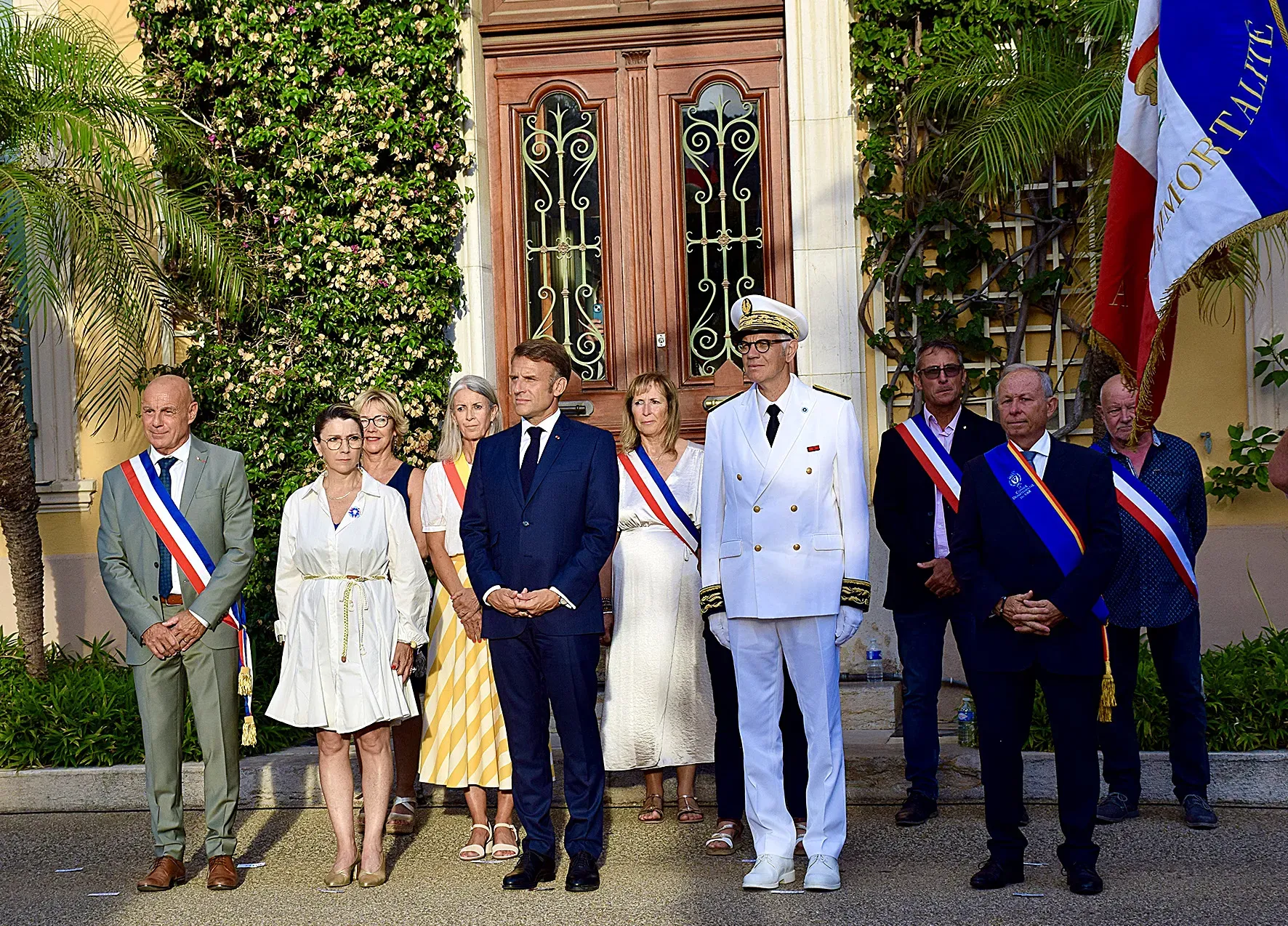
"Let us yield nothing to division. Let us remain that people always capable of overturning the fatality of destiny, that nation standing in solidarity with all those who wish to remain free," insisted the Head of State. Recalling, in his speech, those French citizens who helped with the Provence landing 80 years ago, "ready to give their blood and their dreams, their lifeblood and their hopes, for this universal idea of our nation, for its hope of humanity and progress," the President estimated that "this heritage obliges us." Emmanuel Macron, calling on the French people to live up to those who liberated them, concluded by evoking "a great country, a great people, which we will pass on stronger and more united."

CHILDREN OF ODESSA
The Head of State recalled what France owed, during its liberation, "to the children of Odessa (in Ukraine) and of Europe, of the Maghreb and of Africa, of the Antilles and of the Pacific." For his part, François Arizzi, mayor of Bormes-les-Mimosas, wished to "have a thought for Lana Privé, who left us in September 2023 at the age of 13." He stated: "Lana, even when ill, loved coming to our commemorations and you took the time, Mr. President, with your wife to talk with her, with her family about her hospitalization conditions, regularly asking for news of her. They are not with us tonight for professional reasons, and have asked me to tell you how much you both brought sunshine into the end of their daughter's life. On this day of an important event for our village, I wanted to lay her sash as a member of the Conseil Municipal des Jeunes on the municipality's wreath, so that we may remember." Then the mayor continued: "80 years was yesterday, 80 years is already far away. And yet never since then have the Homeland, France, the values of loyalty, courage, honor, been carried so high. These notions were at the heart of the thoughts of our liberators in 1944. We were fortunate to know several of them, Jo Bonnet, Commandant Bonin, Colonel Planque, Charles Lecat and many others, but also more extensively, Robert Chiazzo the Borméen, and Pierre Velsch whom you, Mr. President of the Republic, elevated to the rank of commander of the Légion d'Honneur. We miss all these men and, beyond being colorful figures with strong characters, they embodied a certain idea of our country. They represented at the time the future of France, a future they wanted to command without being forced to bow to a foreign power, without being forced to adhere to an ideology contrary to their values. When I see some 17-year-old French youths waving foreign flags and spitting on or burning our national flag, I cannot help but think of Pierre Velsch, the pied noir, who at 17, in his native Algérie, lied about his age to enlist and come liberate the motherland, he who, like so many others, swore only by the Blue White Red flag. He was ready to give his life to be able to liberate France Métropolitaine, where he had nevertheless never set foot. A change in behavior, you might say, but it would be wise to ask ourselves what, 80 years later, has happened to our country, our continent, our civilization to find such a change in mentalities. Yet a great ray of hope has just dawned through these cloudy skies" (...).
TRICOLOR FLAG
The mayor added: "For 15 days I felt once again the pride our compatriots have in carrying our tricolor flag, and singing the marseillaise. This is the state of mind we love, that we want to see, it is what makes France strong, so strong. Like the fighters of 1944 did not wait for others, life, or providence to allow them to achieve their dreams or hopes. Pierre Velsch could have stayed in Algérie, hoping the war would turn in favor of the allies. That is not what he did, nor is it what hundreds of thousands, then millions of French people did. That is not what Robert Chiazzo did, by enlisting in the commandos d'Afrique when they passed by his home in Bormes. Their dreams, their hopes, they went out and got them. They wanted to participate, they acted to liberate their country." "All of this, because they loved it, because they nurtured it, because they cherished it. They had left their beliefs and sensibilities in the cloakroom; they gathered around France, the principles of Liberty, equality, and fraternity. In adversity, there was no difference between them; they were brothers in arms fighting and protecting one another. Every single one of them, women and men, was committed to a single goal: to liberate France, Frenchwomen, and Frenchmen. I was speaking to you about patience and effort; the commandos d'Afrique knew how to demonstrate them. They did not become commandos the day they signed their commitment. They knew how to show them before they could embark to do battle. They had to make enormous efforts to train, to learn, and to become extraordinary soldiers. Patience and efforts, but also preparation and discipline, were surely the keys thanks to which the Provence landing went well, and why the capture of Marseille took place at the cost of Allied losses far lower than what the strategists predicted. But it was also due to the fierceness and dynamism of the fighters," stated François Arizzi.
Interview conducted by Francine MARIE Photo Ville de Bormes-les-Mimosas.