The Cavalière ZMEL awarded the 2024 Thomas Joly Prize
In the presence of the préfet of Var and the préfet maritime, a Light Mooring and Equipment Zone (ZMEL) has entered service.
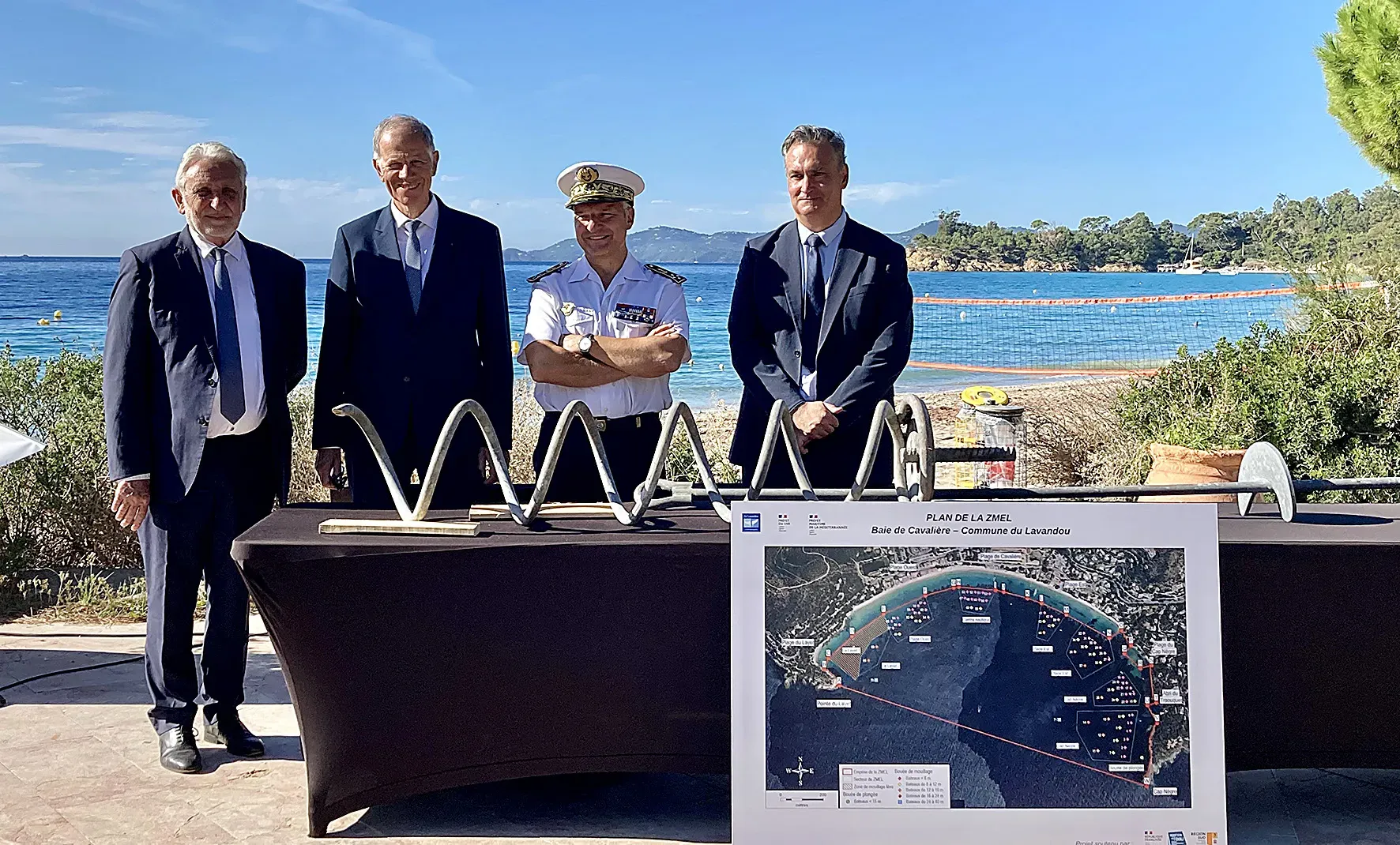
The installation of the ZMEL in the cove of Cavalière was officialised in the presence of Philippe Mahé, préfet of Var, Christophe Lucas, préfet maritime of Méditerranée, Lionel Houllier, deputy director of the DDTM, and Gil Bernardi, mayor of Le Lavandou.
PROTECTING BIODIVERSITY

On this occasion, the mayor specified: "Maritime works will install 71 ecological moorings. The objective is to maintain pleasure boating and strengthen navigation safety while protecting the 83 hectares of Posidonia seagrass meadow in the bay. The ZMEL will also allow the mooring of large vessels, from 24 to 40 metres, which could no longer anchor at this site in accordance with the prefectoral decree of October 14, 2020, regulating the anchoring and stopping of vessels of 24 m and more." The Cavalière ZMEL was awarded the 2024 Thomas Joly Prize in the "restoration and preservation" category. A national prize awarded by the "Pavillon bleu" label, honoring an inspiring initiative in favor of biodiversity each year. Works began on October 22 with an effective use of the anchoring devices scheduled for April 15, 2025. "Since 2019, the préfet maritime of Méditerranée, the State's representative at sea, has initiated a vast policy of protection and preservation of Posidonia seagrass meadows by setting up a regulatory framework for moorings. To support this policy, the ZMEL is the appropriate legal and technical tool to manage the water body and reconcile uses. These temporary parking areas provide an alternative to anchoring for the vessels concerned, while guaranteeing the reversibility of the site's occupation by using liftable installations that are less invasive for the marine environment," recalled the préfet maritime. He added: "While the coastal strip is highly frequented in Méditerranée and nautical leisure activities tend to diversify, it is necessary to organize the use of the maritime space, in particular by ensuring a regulation of vessel flows, in order to guarantee the freedom of movement for everyone, respecting everyone's practices. Thus, by encouraging the development of ZMELs, the State's objective is to ensure the right balance between the preservation of the marine environment, access to nautical leisure activities for all users, and the economic development of the coastline." ZMELs are established all along the French Mediterranean coast. Numbering 41, their size varies from an average of thirty buoys to over 350. To make this strategy operational, two calls for projects were opened in 2020 and 2022 by the State and its public institutions (Office Français de la Biodiversité and Agence de l’Eau Rhône Méditerranée Corse) and the three regions. National funding has been mobilized through France Relance, Destination France, the green fund, and the maritime intervention fund, which can cover up to 80% of the total investment amount in the study or work phase (the remaining 20% being funded by the project leaders' own funds).
For his part, Gil Bernardi specified: "The Anse de Cavalière extends over approximately 1,400 linear coastal metres between the rocky point of Layet to the West and Cap Nègre to the East. It is characterized by a rocky coastline near the point of Layet and Cap Nègre and a sandy beach in the center. The seabed of the bay is mainly sandy with Posidonia seagrass meadows widely developed between 1-5 metres and 35 metres deep. A Posidonia oceanica formation of the 'barrier reef' type is located near the beaches of Cap Nègre. This cove experiences high summer attendance, with up to 220 vessels per day at the peak of the season. Many boaters use wild anchoring, which causes degradation of the seabed, as anchors destroy Posidonia meadows and promote the spread of invasive algae." For his part, the préfet of Var insisted on the role of the ZMEL: "The cove of Cavalière was characterized by the presence of two zones where the State issued temporary occupation permits (AOT) allowing a certain number of boaters (39) to moor their vessels for the summer season. The project submitted by the municipality on May 30, 2023, responds to the need to organize the mooring of vessels in order to take into account the challenges of preserving biodiversity and the landscape while ensuring the safety of using the water body of the cove of Cavalière."
CHARACTERISTICS
In concrete terms, the mooring zone in the cove of Cavalière will occupy an area of 86 hectares and features 71 ecological moorings, as well as a free mooring zone on sandy seabed covering an area of 3.2 hectares. Starting in 2025, it is planned to operate buoy mooring between April 15 and October 30 of each year. Mooring will be free during the day, paid at night, and limited to 7 consecutive nights. The 71 moorings consist of 11 buoys for residents and 3 buoys for professionals. The use of buoys reserved for residents and professionals is subject to the payment of a seasonal fee, with 57 buoys for passing vessels, including 2 mooring buoys for vessels over 24 m. Mooring on one of the 57 buoys located in the mooring sectors is free from 8:00 am to 7:00 pm local time, subject to a fee between 7:00 pm and 8:00 am local time, and limited to seven consecutive nights. The mooring buoys are white and equipped with signage for identification. The existing mooring system located near Cap Nègre, reserved for support vessels for scuba diving flying the alpha flag, is maintained.
FUNDING:
The project benefits from funding from the Agence de l’eau Rhône Méditerranée Corse and the Region amounting to 80% for the study phase (€115,000 excl. tax, i.e., €92,000 of funding) and the works and actions related to management, communication, and awareness (€722,450 excl. tax, i.e., €577,960 of funding). (professionnels or individuals)
Francine Marie - Photo Ville du Lavandou.