Notre-Dame-de-Paris, the stained glass controversy (1935-1965)
At Notre-Dame de Paris, artists and master glassmakers, including Daniel Buren with the Vincent-Petit de Troyes factory, have been selected...
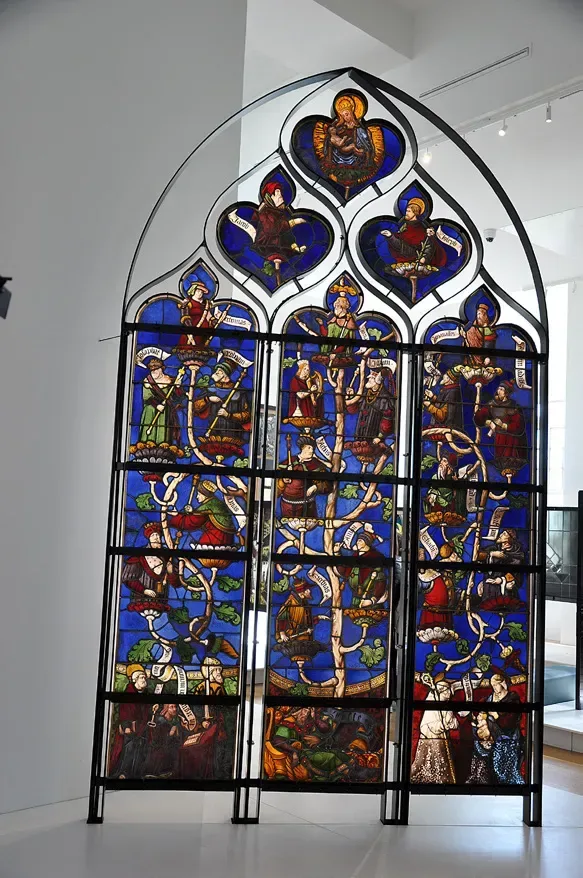
CONTROVERSY This project, initiated by Emmanuel Macron, and defended by the archbishop of Paris Mgr Laurent Ulrich, which is to be figurative, with the Tree of Jesse as a common thread, received an unfavorable opinion from the Commission nationale du patrimoine et de l'architecture.

Cette situation, qui rappelle l'ancienne querelle des vitraux (1935-1965), a amené La Cité du Vitrail, site culturel du département de l’Aube, à faire une exposition sur la querelle, longtemps oubliée, qui opposa « Anciens » et « Modernes » entre 1935 et 1965, autour de l’intégration de vitraux contemporains dans la nef de Notre- Dame, pour remplacer ceux jugés trop ternes, les « grisailles incolores » d’Eugène Viollet Le Duc. Cette querelle méritait d’être présentée au plus large public, tant pour la qualité des œuvres qui en avaient été l’enjeu que pour l’actualité de ses débats. La création contemporaine a-t-elle sa place dans les monuments historiques ? Le journal « L'Époque » titrait en 1938 : « Non ! De grâce pas de vitraux modernes à Notre-Dame » ! « Les détracteurs, moins nombreux virulents, manque d'harmonie de l'ensemble. Pour eux, les vitraux modernes doivent être réservés aux églises contemporaines. Ils craignent aussi de voir déraisonnée contemporaines les souligne Marie Hélène Dider, commissaire générale.

Indeed, there is the international charter of monuments, known as the Venice Charter, prohibiting, in principle, the replacement of existing works with new creations. This situation, reminiscent of the former stained glass controversy (1935-1965), led La Cité du Vitrail, a cultural site of the département de l'Aube, to organize an exhibition on the long-forgotten conflict that pitted the "Anciens" and "Modernes" between 1935 and 1965, around the integration of contemporary stained glass in the nave of Notre-Dame, to replace those deemed too dull, the "grisailles incolores" of Eugène Viollet Le Duc.
This controversy deserved to be presented to the widest possible audience, as much for the quality of the works at stake as for the relevance of its debates. "L'Époque" ran the headline in 1938: "No! For mercy's sake, no modern stained glass at Notre-Dame"! "The detractors, fewer in number but more virulent, criticize the lack of harmony of the whole.
Advertisement
For them, modern stained glass must be reserved for contemporary churches. They also fear seeing an unreasonable propagation of contemporary works in ancient buildings," stresses Marie Hélène Dider, general curator. VIRULENCE OF THE DEBATES La Cité du Vitrail and the conservation des monuments historiques of the DRAC partnered to restore and study the remaining stained glass windows, preserved from history and, for some, from the 2019 fire that ravaged the cathedral where they were stored.
About fifteen of these monumental stained glass windows from the 1930s are on display until next March, in a chapel where natural light magnifies their vibrant colors. Alongside them, models, sketches, painted cartoons, and archival documents (plans, photographs, press articles...) evoke the virulence of the debates that spanned until 1965.
"It is one of the first milestones in the debate surrounding the insertion of contemporary works of art into an ancient building.
It mobilized a very large number of heritage stakeholders," says Julia Boyon, curator of the exhibition. At the time, the project led by 12 master glassmakers, among the most renowned of their generation, provoked strong resistance that led to a real disagreement. Opposing the supporters of an unalterable respect for ancient heritage, which none could equal, were the defenders of a renewal of sacred art through modern creation.
Although this artistic proposal, disrupted by many turnarounds, never saw the light of day, several stained glass windows as well as numerous archival documents still bear witness to this affair which inflamed the heritage world and public opinion for nearly thirty years.
Visitors can thus discover, as they go through the rooms of the exhibition, the major stages of the controversy, its aesthetic and historical stakes, as well as the stained glass windows and archives that survived.

Bernard BERTUCCO VAN DAMME, special correspondent in Troyes.