Saint-John Perse, a poet on the Giens peninsula
The writer is highlighted by two artists, Sandrine Expilly and Miriam Hartmann.
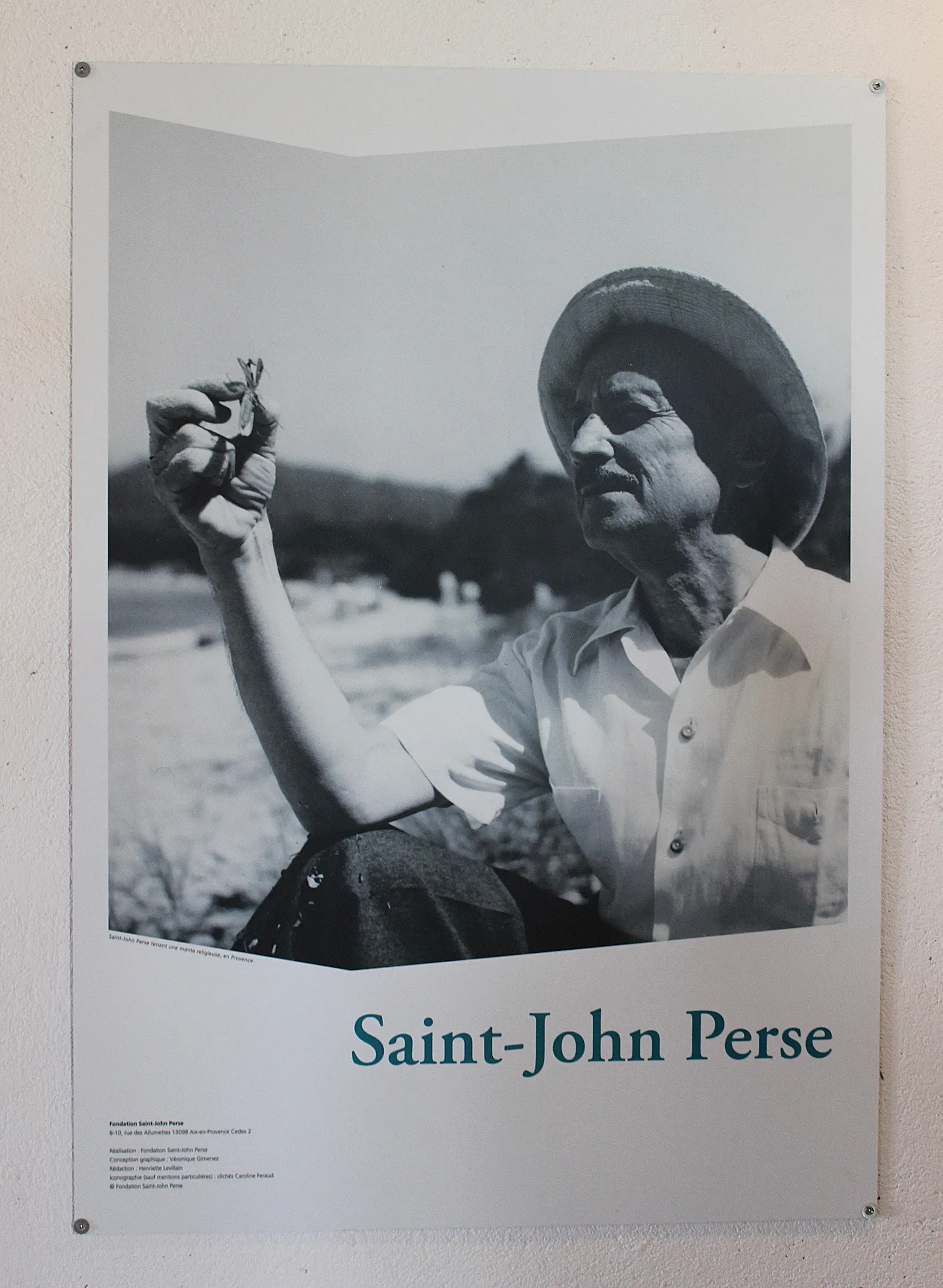

diplomate. Alexis Leger dit Saint-John Perse est né en 1887 à Pointe-à-Pitre et est mort à Hyères en 1975. Le pseudonyme, Saint-John Perse est associé à ses œuvres poétiques. Le nom, Alexis Leger, fait référence à l’homme diplomate de la 3ème République. Cet homme, tour à tour, secrétaire d’Ambassade, haut fonctionnaire au Quai d’Orsay, poète exilé aux États-Unis et Prix Nobel de littérature en 1960, a inspiré énormément d’artistes, notamment, Georges Braque, Lucien Clergue...Muriel Calvet, Directrice de la Fondation Saint-John mentionne que le poète a fait don de l’ensemble de ses collections à la Cité Aixoise, par l’intermédiaire d’un de ses amis, Pierre Guerre, avocat marseillais, amoureux de la poésie et de la littérature. La Fondation, créée en 1976, possède tout le fonds, le but est également de soutenir la poésie contemporaine ». Muriel Calvet a réuni Sandrine Expilly et Miriam Hartmann, deux artistes sur les traces de Saint-John Perse. « Ce sont des rencontres qui arrivent au même endroit mais qui ne partent pas du même lieu », précise la directrice. « L’exposition aux Salins des Pesquiers est une exposition documentaire sur le poète Saint-John Perse. Le poète a terminé sa vie à Giens, il a écrit ici les derniers textes de sa vie. Cette exposition a un sens de montrer qui était Saint-John Perse », confie Muriel Calvet. Il était sur la terrasse de sa maison des Vigneaux à Giens quand il a reçu le Prix Nobel de littérature, en 1960. La directrice de la Fondation souligne également : « Saint-John Perse a cessé d’écrire de la poésie quand il occupait les fonctions de diplomate ». Et c’est seulement lors de son exil, que le poète s’est remis à l’écriture.
Two artists, so different in their approach and their works, in the footsteps of Saint-John Perse, poet and diplomat. Alexis Leger, known as Saint-John Perse, was born in 1887 in Pointe-à-Pitre and died in Hyères in 1975. The pseudonym Saint-John Perse is associated with his poetic works.
The name, Alexis Leger, refers to the diplomat of the Third Republic. This man, in turn embassy secretary, high official at the Quai d'Orsay, exiled poet in the United States, and Nobel Prize in Literature winner in 1960, has inspired countless artists, including Georges Braque and Lucien Clergue...
Encounters around Saint-John Perse. Muriel Calvet, Director of the Fondation Saint-John Perse in Aix-en-Provence, mentions that the poet donated all of his collections to the city of Aix, through one of his friends, Pierre Guerre, a Marseille lawyer and lover of poetry and literature. “The Foundation, created in 1976, owns the entire collection; the goal is also to support contemporary poetry.” Muriel Calvet brought together Sandrine Expilly and Miriam Hartmann, two artists in the footsteps of Saint-John Perse.
Advertisement
“These are encounters that arrive at the same place but do not start from the same point,” specifies the director. “The exhibition at the Salins des Pesquiers is a documentary exhibition on the poet Saint-John Perse. The poet ended his life in Giens; he wrote the final texts of his life here.”
“This exhibition has a purpose to show who Saint-John Perse was,” confides Muriel Calvet. He was on the terrace of his house, Vigneaux, in Giens when he received the Nobel Prize in Literature in 1960. The Foundation's director also highlights: “Saint-John Perse stopped writing poetry when he held his diplomatic positions.”
And it was only during his exile that the poet returned to writing.
Praise to the earth. Sandrine Expilly, a photographer wandering through the same places as the poet, produced a series of photographs called “Gaïa Ô terre”. She confides: “Saint-John Perse intended to write a final collection entitled Gaïa, which was never published; it was a praise to the earth.” The starting point for this artist is this mystery surrounding the collection.
The photographer continues: “I was inspired by the poems written under the Mediterranean light by Saint-John Perse on the Giens peninsula, as well as other older ones.” Sandrine Expilly focused on his final home, Vigneaux on the Giens peninsula, Saint-John Perse's place of residence from 1957, a generous gift from Mrs Henry Tomlinson Curtiss, an American friend of the poet.
Sandrine Expilly, through her photographs, specifies: “I started with something sensory, on the boundary between land and sea, trying to link the documentary side with a more dreamlike, fictional part. The images are reworked with graphite and charcoal.” The artist-photographer is intimately convinced that Saint-John Perse's poems are not just words.
The poet is inhabited by the surrounding landscape. She adds: “There is a very intimate link between him, the words, the air, the elements.” She chose to show the maritime horizon because that was the view Saint-John Perse had from his house.
This love for nature. Saint-John Perse loved plants, stones, animals, and the sea.
Advertisement
Every morning on the terrace of his house, Vigneaux, he would hoist a French flag and a Chinese calligraphy flag with ideograms of his name “Leger”, written in an approximate way. He had this characteristic posture with his hand in his pocket, his gaze turned towards the sea, and binoculars in his other hand. “He also bathed every morning,” confides Muriel Calvet.
Painting and the collection “Amers”. The approach of Miriam Hartmann, painter, is made through painting and writing. The paintings of this German artist resonate with a single collection, “Amers” (1957). The work of Saint-John Perse comprises four cycles: Antilles, Asie, Amérique, Provence. “Amers” is part of the American cycle.
Miriam Hartmann did not know Saint-John Perse at first. She was amazed at first sight by the poet's texts. An exhibition and residency at LM-Studio in Hyères in 2022 allowed her to exhibit her work on the Saint-John Perse Project.
She explains: “I chose to take a whole poem to enter the poet's work without trying to understand; that was the key, the fluidity. Saint-John Perse speaks a lot with images and colors. During my readings, I sketch what is in my head in my sketchbook, and then turn it into a painting with which I associate the poet's quotes.”
Approaching the word. Miriam Hartmann, through her paintings, shares her thoughts: “It is not to provide a key to reading, and certainly not an interpretation. I chose painting, non-verbal, to approach the word. Explaining it would limit it.
But I would like to share a few traces. Come with me, if you wish. But open your own eyes.”
What a magnificent resonance with this excerpt from Saint-John Perse's poem: “And it is a song of the sea such as was never sung, and it is the Sea in us that will sing it.”
“Sécheresse”. The last poem, “Sécheresse”, by Saint-John Perse was written in 1974, shortly before his death.
Here is an excerpt: “The dogs go down with us on the deceitful tracks. And Midi l'Aboyeur searches for his dead in the trenches filled with migratory insects. But our roads are elsewhere, our hours demented, and, gnawed by lucidity, drunk with bad weather, behold, we advance one evening into God's land like a starving people who have devoured their seeds” (...)
.
Laurette PARAY.