In La Seyne-sur-Mer, AI serves the abyss
Following the World Summit for Action on Artificial Intelligence held in Paris at the initiative of the President of the Republic, Agnès Pannier-Runacher...
Her visit began with a presentation of the Naval Group site and the role of AI at sea in Ollioules, then continued with a visit to the IFREMER Mediterranean center in the port area of Brégaillon, where the minister was welcomed by Jo Minitti, deputy for port policy, representing Nathalie Bicais, mayor of La Seyne-sur-Mer, and Frédéric Boccaletti, Member of Parliament for the constituency.
Located in the bay of Toulon, a strategic position for deep-sea access, the La Seyne-sur-Mer site is one of the leading scientific ports in Europe. With its 400 linear meters of quayside, it can accommodate vessels from the French Oceanographic Fleet operated by IFREMER and personnel from Genavir, a subsidiary of the institute responsible for operating them. According to François Houllier, Chairman and CEO of IFREMER: "France has two assets: an outstanding scientific community and the second largest Exclusive Economic Zone (EEZ) in the world, thanks to our overseas territories."
ARTIFICIAL INTELLIGENCE AND BLUE ECONOMY The minister discussed the role of Artificial Intelligence (AI) for deep-sea research.

The development of AI within the Pôle Mer Méditerranée was, therefore, at the center of this ministerial visit. Thus, the minister discovered the latest applications in deep-sea topography, resource management, and aquaculture. For this first visit to the bay, the minister chose Brégaillon, Europe's leading scientific port.
Advertisement
"The sea is the primary carbon sink.
It is also an element of food sovereignty for 3 billion human beings. And yet, we know the surface of the moon better than that of our deep seas," remarked Agnès Pannier-Runacher. Speaking about AI, she added: "It will help accelerate the collection of information on fishery resources, the impact of climate change, but also illegal trafficking, at a time when President Macron has signed a moratorium on deep-sea mining."
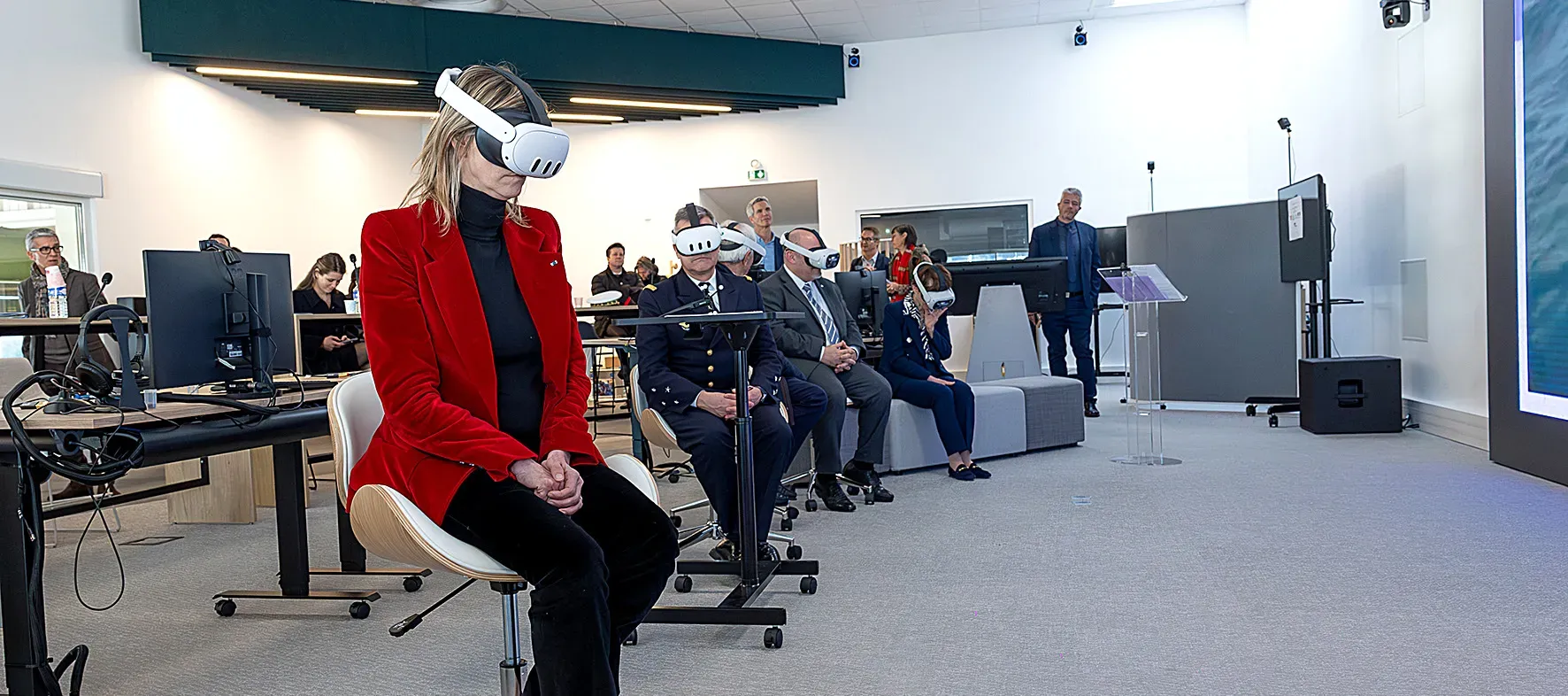
For Vincent Rigaud, director of the IFREMER Mediterranean Center: "The Brégaillon site, at the heart of the Pôle Mer and Naval Group ecosystem, offers a tool of international caliber. From manned diving to piloted diving, our ROVs (remotely operated underwater vehicles), based on site, offer some of the best solutions." VIRTUAL REALITY Shortly after, equipped with a headset, the minister embarked on a dive in the virtual reality hall into the Cassidaigne underwater canyon off the coast of Cassis.


Furthermore, within the framework of France 2030 and the MinArm deep-sea control strategy, the Direction Générale de l'Armement and the Marine nationale will benefit from the creation of a clone of Ulyx.
Currently, there is a fleet of 6 on-board submarines, named Victor, Arthur, Nautile, Ulyx, and Ariane. Manned or remotely operated, gliding or rolling, or able to be loaded onto a simple fishing boat or a larger unit, the submarines adapt to any type of mission: "Ulyx, for example, is an underwater drone that can dive down to 6,000 meters deep. With 24 hours of endurance covering 70 km², it features mapping sonar and optical inspection, but also decision-making autonomy, thanks to its onboard intelligence," explained Jan Opderbecke, head of the underwater systems unit.
Photos Philippe OLIVIER.