Veolia recruits 1 employee in France every 20 minutes!
The Sud region is heavily impacted by ecological challenges, as highlighted by the 2024 Ecological Transformation Barometer, conducted by Elabe...
According to the results of this barometer, 66% of the region's inhabitants feel exposed and vulnerable to climate change. This is because it will have repercussions on the economy, particularly on tourism and agriculture. The Provençaux are aware that these changes could have consequences on their living conditions, making them increasingly vulnerable.
ECOLOGICAL TRANSFORMATION

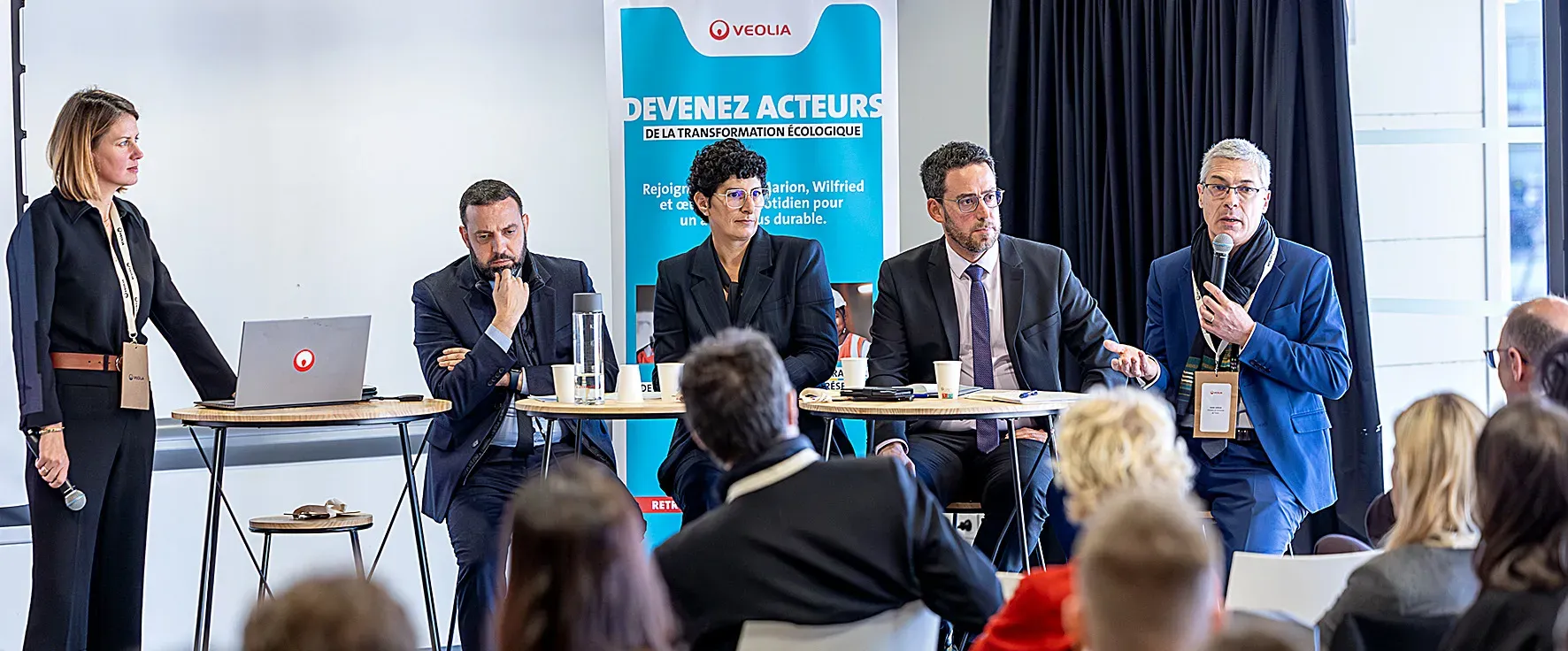
Hence the need to develop green economy jobs. Thus, on February 6, an informative meeting on "Our professions in the service of ecological transformation" brought together numerous experts at the Palais de la Mer in Toulon, on the initiative of Veolia. For Diana Le Meur, Director of Communication for Veolia Eau Méditerranée: "Solutions exist. Others have yet to be invented. We will need the expertise of our partners to implement them." This meeting was part of a series of three events organized in the Sud region by Veolia on employment, training, and integration for ecological transformation. Through interactive workshops, participants interacted with HR from the group's companies and their employees, who shared their career paths and daily missions. A round table allowed for rich discussions with exceptional guests: Jean-Baptiste Morinaud, Deputy Secretary General of the Var Prefecture in charge of priority city districts, Xavier Leroux, President of the Université de Toulon, Linda Khenniche, Deputy Regional Director of France Travail, and Romain Torres, Human Resources Director of Veolia France.
LOCAL ANCHORING
Regional Director of Veolia Eau Méditerranée, Éric Lahaye presented activities in the Sud region and questioned the needs in terms of ecological transformation and how to meet them. In his introductory speech, he emphasized the company's local footprint. Thus, he explained: "With 66% of residents admitting their fears, two-thirds of the population is concerned. For these issues, we know that inaction will be more costly than action. Doing nothing will cost us more tomorrow than acting now. Veolia is committed to implementing local solutions and making ecological transformation a reality by offering tailored solutions. This is also reflected in the commitment of our 6,000 employees and the recruitment of 500 permanent contracts (CDI) each year, including 200 work-study trainees." Éric Lahaye added: "We are deploying significant resources to face these challenges. Our strength is the local anchoring of our teams, placing them where needs are felt, mainly along the coastline, where most of the population is concentrated." Activities are organized around water management, waste treatment, and energy transition, with the goals of decarbonizing clients' activities, optimizing resource use, and preserving the environment. And the ARIANEO project in Alpes-Maritimes (25,000 homes and 13 housing units) illustrates Veolia's expertise. Furthermore, saving and regenerating in virtuous local loops helps strengthen energy and food sovereignty, reduce pressure on ecosystems, and preserve soil. Finally, Veolia designs and deploys detection, treatment, and elimination systems for pollutants in the air, water, and soil. Implementing these solutions is essential to reconcile reindustrialization, biodiversity preservation, and residents' health.
PROMOTING GREEN JOBS
According to Linda Khenniche (France Travail): "The economic context is uncertain. We are seeing a slight slowdown in job offers and a slight increase in job applications, especially among young people." For Jean-Baptiste Morinaud, sub-prefect: "The question is how we guide professional careers. Even though the unemployment rate in Var is below the national average, we cannot be satisfied with these figures (7.2% in Var compared to 7.6 in France). In the face of this challenge, strategic and energy independence depends on maintaining the industrial fabric. We must therefore sustain employment in the territory and not pit ecological transition against economic development." He continued: "Veolia's niche is highly promising. We must value it and succeed in promoting these careers to young people. We need to make these professions visible, value them, and give them meaning. Employment in impoverished areas struggles to pick up due to difficulties in accessing jobs. This is the challenge of vocational training and particularly work-study programs. In the face of this situation, the State must also adapt and help companies do the same, as is already the case with France 2030. We must ask ourselves how to boost virtuous companies that are developing green technologies. In short, to break down the barrier between the private and public worlds." President of the Université de Toulon (10,500 students, 9 departments, 14 laboratories, two campuses, and an annex in Draguignan), Xavier Leroux assured: "Environmental issues are at the heart of education and research. The question of ecological transition is also integrated into all our training programs and as soon as a project is set up. All students are made aware of environmental issues, degrees are geared towards sustainable tourism, and training programs are directly targeted at coastal and environmental issues." Finally, Romain Torres, HRD of Veolia France, insisted on the need to co-build with local employment and training actors: "Veolia is among the 10 largest recruiters in France, and we hire someone every 20 minutes. We believe that by combining external recruitment, continuous training, and internal mobility, we can meet the challenges of ecological transformation, and for that, we need to work hand in hand with regional stakeholders."
Photos Philippe OLIVIER (article and photo page).