François de Canson: "Our region is more attractive than ever"!
On April 4 at Villa Cosy (Saint-Tropez), for the high tourist season launch before 250 professionals, François de Canson, president...
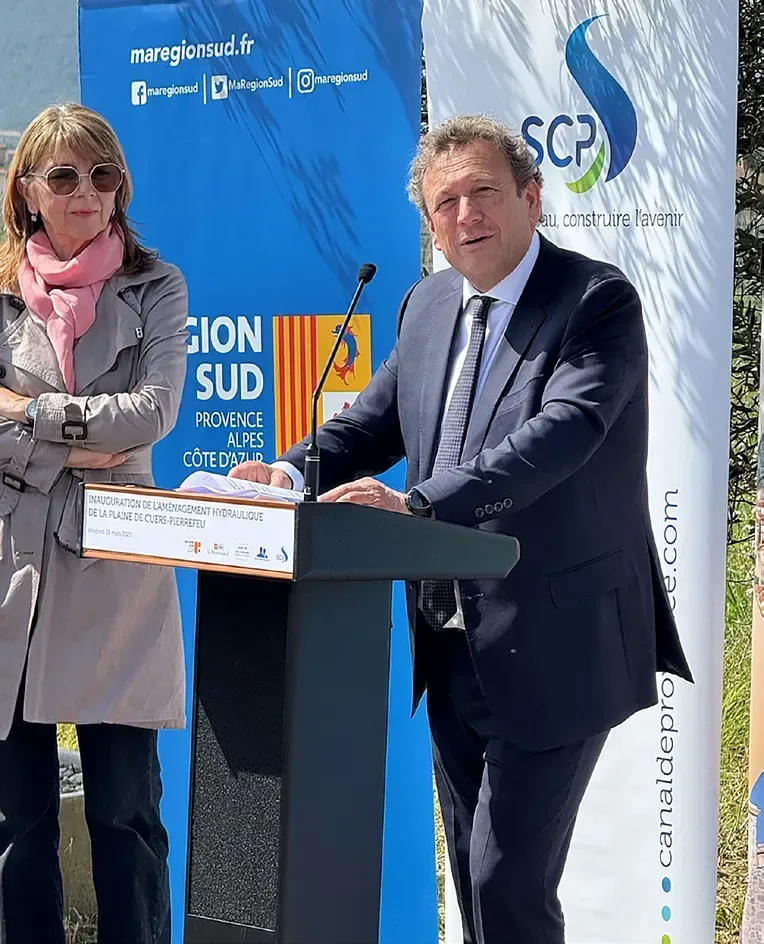
For the vice-president of the Région, it is a matter of moving forward together by building common budgets to be stronger. Because tourism is a heavyweight of the regional economy with 21 billion in economic benefits, 13% of GDP, 150,000 jobs, and 25,000 companies. It is even the leading industry.
François de Canson answers questions from La Gazette du Var. What are the prospects for 2025? François de CANSON.
The high season is looking very promising, with reservation rates identical to those of 2024, an exceptional year. Driven by particularly successful international events such as the Olympic and Paralympic Games, which allowed us to record 200 million in economic benefits, the 80th anniversary of the Débarquement de la Libération de Provence, and unprecedented promotional investments. Quite simply, 2024 has become the new benchmark year for regional tourism.
Advertisement
The region is even the only one in France, along with Corse, to record rising results. Across our entire territory, attendance increased by 3%, thanks to the dynamism of international clientele (+4%). In traditional hotels, the increase is 1.5%.
And in outdoor hospitality, it is 6% and in rentals over 10%.
Particularly in the golfe de Saint-Tropez? Fdc. Indeed.
Here, 52% of hotel overnight stays are by international clientele compared to 30% for Var hotels and 37% in regional hotels. Yes, the Saint-Tropez hotel industry is exceptional! Saint-Tropez is the municipality in the region with the most 5-star hotels (12 as of January 1, 2025), far ahead of the 2nd city (Cannes with 7 hotels) and the 3rd city (Nice with 6 hotels).
On a national level, Saint-Tropez ranks 3rd behind Paris (111 hotels) and Courchevel (23 hotels).
Our region is more attractive than ever, and its international reputation continues to grow. Proof of this is the healthy state of air traffic, which increased by 16% this year. How do you plan to stay on course?
Fdc. For the coming years, we will continue to adapt our tourism strategy. With 237 million overnight stays and 37 million stays generated in 2024, the region constitutes a major tourist destination that knows how to manage its flows.
For example in the hotel industry in 2019, summer represented 30% of overnight stays, whereas today it represents "only" 27%. A result explained, in part, by focusing the promotion of our destinations off-season for several years now, to stimulate stays during other seasons and better spread attendance over time.
Advertisement
Furthermore, for the sake of consistency, we felt it appropriate to merge the promotion of business tourism, led by Linkeus, and the promotion of leisure tourism within the Comité régional de tourisme. And regarding flow management, how do you proceed? Fdc.
The Région Sud supports "sensitive" sites that wish it. First, through observation to collect as much useful data as possible to facilitate decision-making via, for example, eco-counters and customer reviews left by visitors. Second, with on-site development assistance through the Région's support system for "Sites touristiques exemplaires".
Then, with the support of the CRT in improving communication around sensitive sites.
Do you also advocate for decarbonization and sustainable mobility? Fdc.
Nearly 70% of greenhouse gas emissions from the tourism sector are linked to visitor transport (both incoming and within the territory), so acting for more sustainable mobility is a priority for the region. For two years now, attractive offers aimed at encouraging tourists to travel by public transport (bus and train) have been set up by the Région. And it is effective, since in 10 years, the share of train use by tourists has increased from 4% to 14%.
Significant efforts are also being made, in connection with other mobility organizing authorities, to develop bicycle touring.
Let me remind you that 22 million French people declare they cycle during their holidays. The region has 3,600 kilometers of cycling routes, and 1,108 facilities benefit from the "Accueil Vélo" label. Finally, is the region a protected area?
Fdc. Considerable efforts are made by the Région to protect our setting. Today, 60% of the regional territory is located within a protected natural area, which is more than any other region in France!
Specifically, we have 4 Parcs nationaux (Calanques, Écrins, Mercantour, and Port-Cros) and 9 Parcs naturels régionaux (Alpilles, Baronnies provençales, Camargue, Luberon, Préalpes d'Azur, Queyras, Sainte-Baume, Mont Ventoux, and Verdon). This momentum will continue in the coming months, particularly with the project of a 10th Parc naturel régional in the Maures, Estérel, and Tanneron massifs.
53 municipalities of Var and Alpes-Maritimes are concerned and 47 have already deliberated.