La Gazette du Var met Claire Tingaud.
What is your background?
Is movement a part of you?

J’ai eu la chance de faire des activités manuelles très tôt et de croiser Depuis que je suis née, j’ai toujours été en itinérance. Mes parents exerçaient un métier qui nécessitait de déménager très souvent. Le mouvement et la découverte de nouveaux lieux font partie de moi. C’est ce qui fait la personne que je suis aujourd’hui. Dans mon travail, en arrièreplan, cette nécessité et cette envie de découvrir de nouveaux lieux et de nouvelles personnes assez régulièrement sont très présentes. Cela me nourrit énormément, c’est pour cette raison que je fais beaucoup de résidences, que le travail que je mène artistiquement se trouve sur des territoires différents. Mon travail est lié aux paysages et aux rencontres que je fais sur les terrains.

The connection to the sensitive and the invisible, and the senses awakened?
Advertisement
Through my artistic work, I try to convey an atmosphere. In a place, I have this feeling of being permeated by all the senses: sight, hearing, smell, and the materials around me. It is like an exacerbation of the senses; everything is densified in terms of the perception of everything around me. I can extract these sensations to transcribe them through artistic productions. I have a very strong connection to the touch of materials; I use textile techniques to assemble materials. In terms of scenography, the pieces I produce are suspended, which is a format that regularly recurs because there is a very strong relationship to space, atmosphere, and the sensory.
With pieces woven in the Salins?
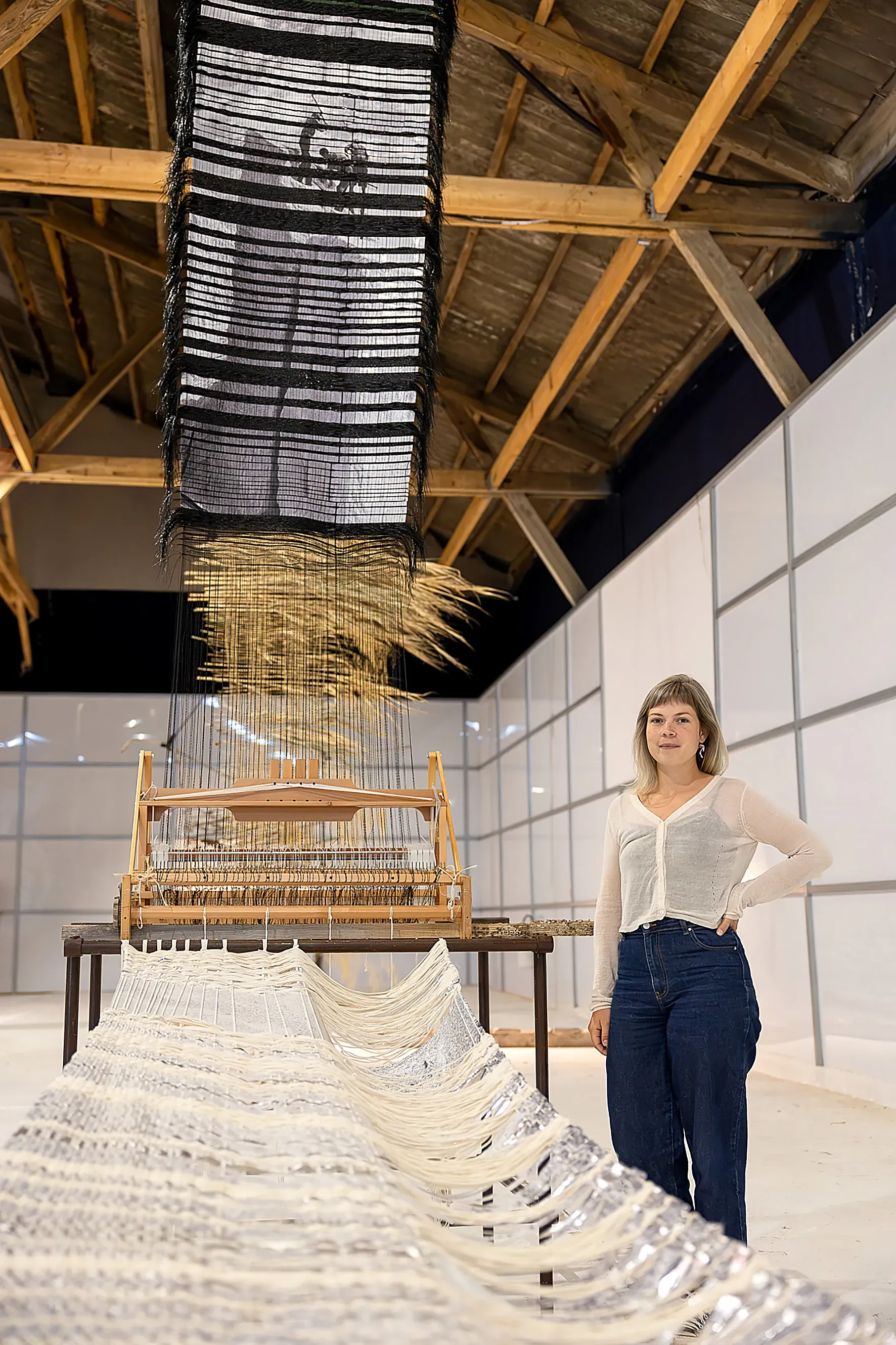
For four weeks, I was in the heart of the Salins. All the materials used were gathered on site, in agreement with the staff. Woven pieces were able to convey this entire atmosphere that marked me visually and sensorially. The "human work" aspect was present through the buildings and the tools—many made of rusted, oxidized metal buried in the sand and also stored in the workshops of the workers, the salt workers who work on site. The "plant" aspect was present with all the plants on the site, such as the canne de Provence that grows wildly on the land. I made weavings using geotextile sheeting, which is used to preserve dune areas. I unwove it and recovered the black fiber. This material reminded me of the mud present in the marshes. I worked with an analog black and white photo that I took of the surface of the Salins: you can see the movement of the salt on the surface. As the photo was rewoven with other materials, you only see the material. This photo blends with unbleached cotton rope and vapor barrier.
And texts written with the material present in the Salins?
I wrote a text in the Salins that I transcribed onto strips of fabric from the workshops of the Salins workers. I soaked them with the rusted tools to patinate the fabric, which helps fix the pigments. Rust is a natural pigment fixative. The text was written with the mud from the Salins, with sediment from the soil of the Salins, a very clayey black paste. I created everything on site, in immersion.
Interview conducted by Laurette PARAY. Photos by Philippe OLIVIER.