The Clemenceau 2025 mission, an essential actor in maritime security
On April 25, the GAN returned to Toulon after a five-month operational deployment from the Mediterranean to the Pacific Ocean.
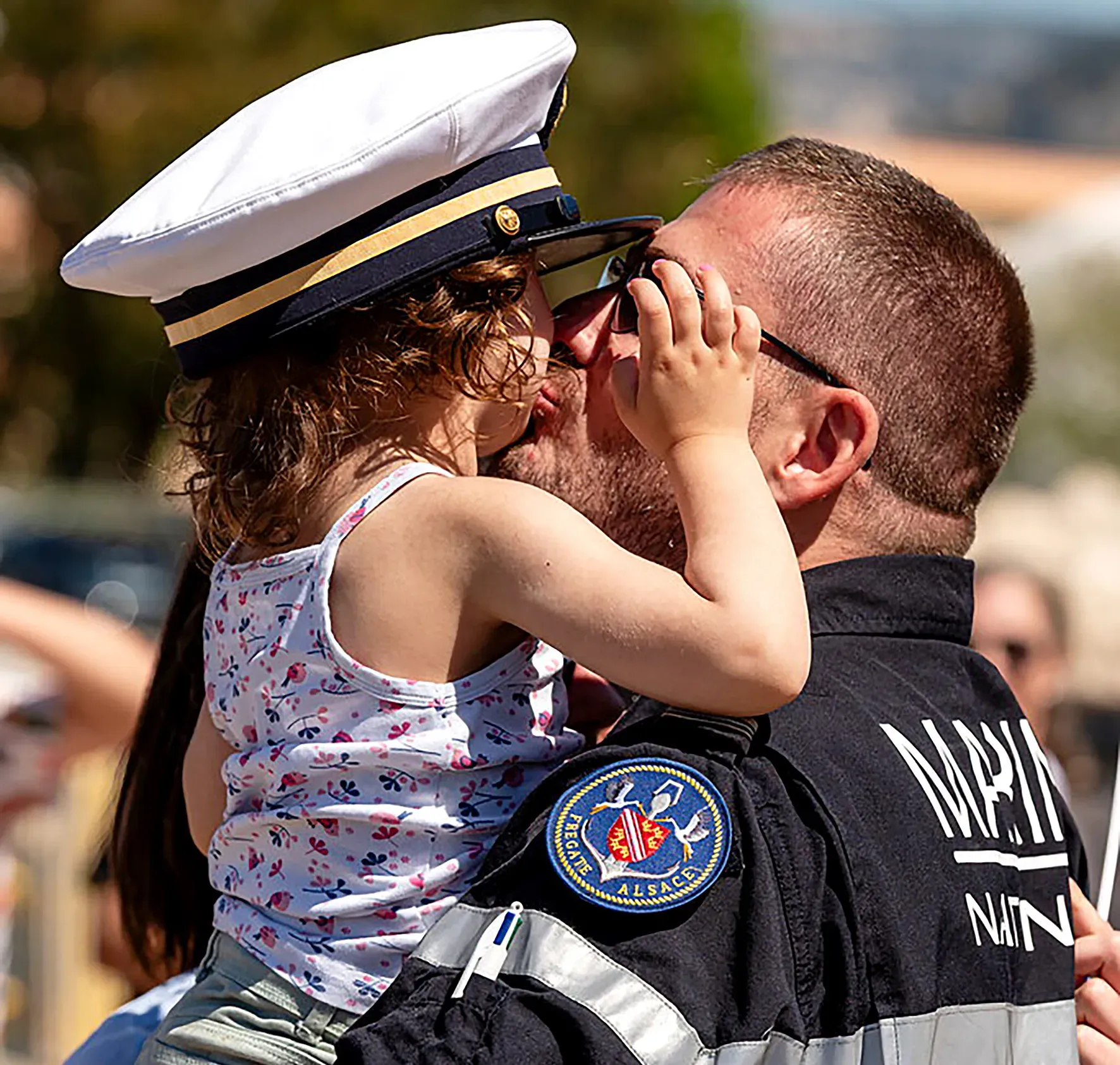
Nearly 3,000 sailors involved in the CLEMENCEAU 25 mission worked for 150 days to conduct numerous naval activities. This mission demonstrated France's commitment to preserving freedom of navigation in accordance with international law and interacting with around twenty allied or partner countries with similar ambitions across a range of diverse missions, ranging from maritime security to high-intensity operations between several aircraft carriers.
However, the return was marked by the disappearance at sea of second-maître Léo Soulas, deployed within the carrier strike group since November 28, 2024. The Marine nationale associated itself with the grief of the family, loved ones, and brothers-in-arms of this exemplary sailor.


PARTNERSHIPS After 5 months of deployment from the Mediterranean to the Pacific Ocean, the ships of the carrier strike group (GAN), composed of the aircraft carrier Charles de Gaulle, the embarked air group and staff, three frigates, the force replenishment vessel (BRF) Jacques Chevallier, and a nuclear attack submarine, docked in Toulon on April 25, at the end of an exceptional mission due to the diversity of the operations conducted, the partnerships developed, and the areas crossed. Thus, the GAN demonstrated its capability to act as a naval force aggregator by integrating allied or partner escorts, including 6 frigates (in chronological order: Italian, American, Greek, Portuguese, and Moroccan). These assets were reinforced by detachments of Atlantique 2 maritime patrol aircraft based in Djibouti, Indonesia, the Philippines, and Singapore.
Advertisement
Contributing to the security of Europe, the GAN contributed to the situational assessment in the Near and Middle East, conducted flights over the Black Sea to reaffirm freedom of navigation in this contested area, and integrated into exercise NEPTUNE STRIKE, reinforcing NATO's collective defense.
In the Indo-Pacific, 4 major activities shaped its deployment. First, exercise LA PEROUSE 25, in January, brought together Australia, Canada, the United States, France, India, Indonesia, Malaysia, the United Kingdom, and Singapore, to improve expertise in maritime security in the straits of the Indonesian archipelago of Malacca, Sunda, and Lombok. HIGH LEVEL OF INTEROPERABILITY The RASTABAN projection mission, in January, allowed the deployment of three Rafale Marine to Darwin (Australia) from the south of the Indonesian archipelago, nearly 2,000 km from the GAN, and to conduct air combat training with F-35s from the Royal Australian Air Force.
In February, the unprecedented Multi Large Deck Event PACIFIC STELLER, with the American and Japanese navies, brought together 3 aircraft carriers and more than 100 aircraft in a high-intensity exercise, achieving a high level of interoperability. Finally, the 42nd edition of the multi-domain exercise VARUNA, in March, with the Indian Navy, a strategic partner in the region, integrated the Indian aircraft carrier Vikrant for the first time.
The various port calls of the mission made it possible to develop new logistical support points such as Lombok in Indonesia and Subic Bay in the Philippines for the aircraft carrier Charles de Gaulle, as well as Darwin in Australia and Okinawa in Japan for the BRF Jacques Chevallier. This deployment provided a fertile ground for numerous experiments on tactical data collection and analysis, as well as in the logistics field. It allowed the GAN to familiarize itself with the specific conditions of this region to deploy its assets and adapt to both the environment and its actors.
CLEMENCEAU 25 involved nearly 3,000 sailors who worked to conduct 4 major multinational naval activities, 2,500 catapult launches, 100 replenishments at sea (including 20 for foreign vessels), and 40,000 nautical miles traveled, equivalent to 2 round-the-world trips.
Photos Marine nationale.