After the floods, it is holiday time in Cavalière
On June 24, a month after the disaster in Le Lavandou, the préfet du Var opened the bypass of the Cavalière bridge, weakened by the floods.
Indeed, following the floods of May 20, the bridge crossing the Quicule stream (RD 559), the Département introduced single-lane traffic, and vehicles over 3.5 tonnes are banned. In this context, the Ville du Lavandou began work on June 12 to create a diversion route bypassing the bridge via the vallon de Cavalière to ensure traffic continuity on this route connecting Le Lavandou to the golfe de Saint-Tropez for vehicles between 3.5 and 19 tonnes. As such, State services worked alongside the municipality, Méditerranée Porte des Maures, and the Département to identify solutions for a return to normal as quickly as possible and to preserve everyone's safety.
EXCEPTIONAL SOLIDARITY

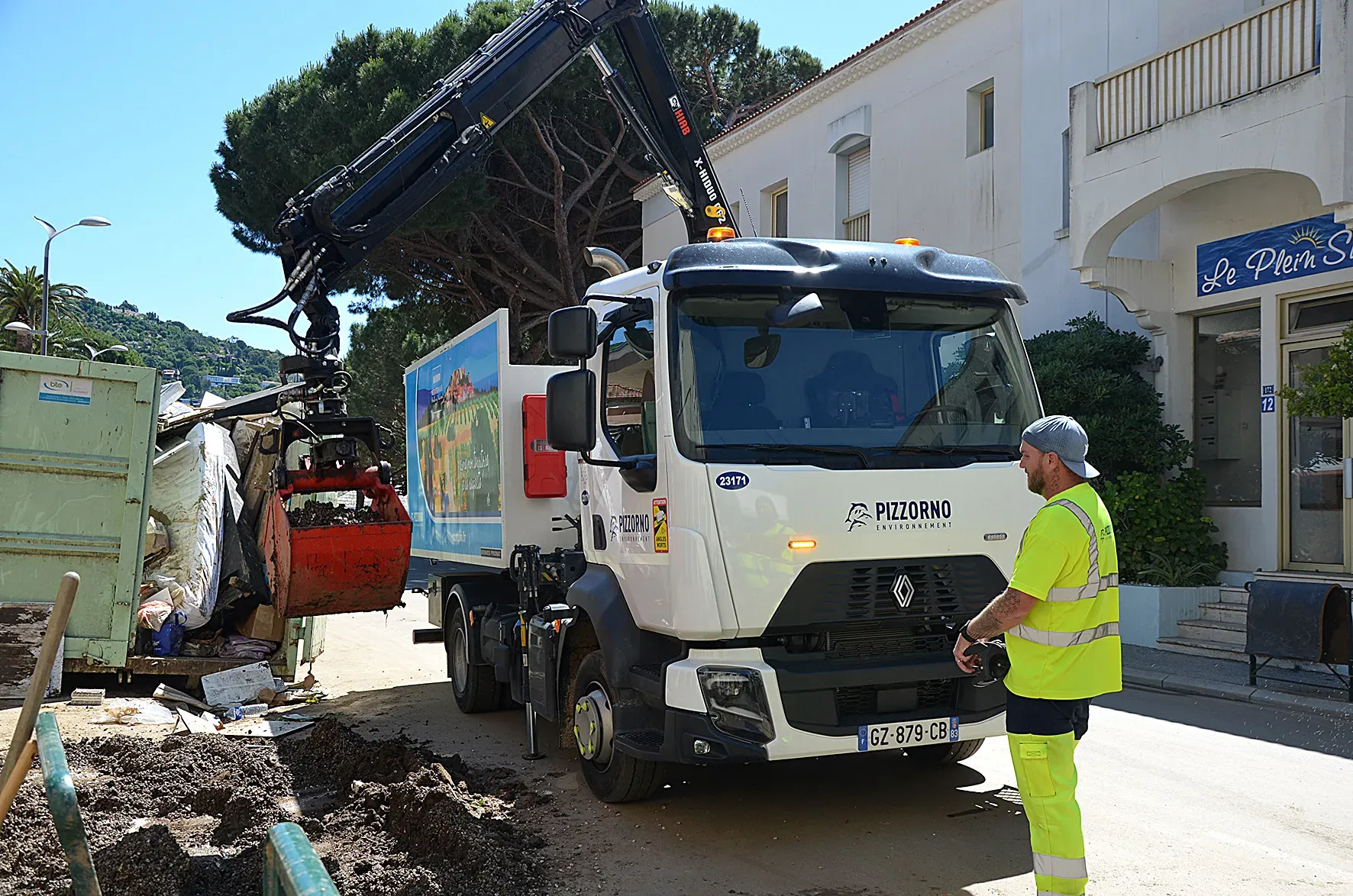
Elsewhere in town, less than a week after the floods, most beaches were open for swimming. However, after this natural disaster which heavily impacted the region, much remains to be done. The mobilization and commitment of the entire community made it possible to overcome this ordeal and open the bathing season under the best possible auspices. Thus, hundreds of women and men committed themselves to helping the victims, supporting the efforts of the municipality. Among those mobilized: elected officials, municipal employees of Le Lavandou and neighboring towns, volunteers, and association members. The town was also able to rely on the services of the State, the Région, and the Département, forming an incredible chain of solidarity set up in the week following the bad weather! Thus, drinking water was redistributed in the Cavalière district as early as May 26, while the clearing of the wastewater treatment plant (flooded and filled with mud) was carried out alongside electrical work and machine testing. Record time to bring the Cavalière station and pumping station back into operation. During a crisis meeting with State services, elected officials asked the companies SAUR and BONNA TP (underwater works) to find quick solutions to connect the 100 meters of the outfall pipe running from the bridge to the sea. On the administrative side, the good news arrived with the interministerial decree recognizing the state of natural disaster, published in the Journal Officiel on May 28. Consequently, victims had 30 days to file their claims, with a guarantee of compensation within 21 days. As for the victims, the 50 people temporarily rehoused in hotels have returned home. The hotel de La Calanque had immediately made rooms available to them free of charge. Alongside the hard-hit residents, operational teams continued their clearing and cleaning work without respite. Thus, the damaged lifeguard station was reinstalled, while the collapsed areas behind the beach are being repaired. Over the Ascension weekend, teams remained mobilized.
A Mass in the church of Saint-Louis

The Sunday Mass on May 25 paid a special tribute to the victims, those affected, and all those who helped enable a rapid restoration. In the presence of the mayor and many parishioners, Father Pierre Pommeret, parish priest of the Saint-Louis parish, brought together in prayer those most affected by grief, uncertainty, and material damage. He spoke of 'a time of sharing to find hope and peace after such a weather event which, in a few minutes, surpassed all forecasts (...). I believe that through this ordeal, there is a feeling of gratitude for all the goodwill that has been shown. Peace to men of goodwill, this is God's promise made to the shepherds on the night of Christ's birth. This is also the wish I make today for everyone: may peace be with you who seek the good.'


Text and photos Francine Marie.