François de Canson: 'Tomorrow, AI will represent hundreds of skilled jobs'
François de Canson, vice-president of the Région Sud, recalled the challenges of embedded AI at the presentation of the Trophées Var Matin.
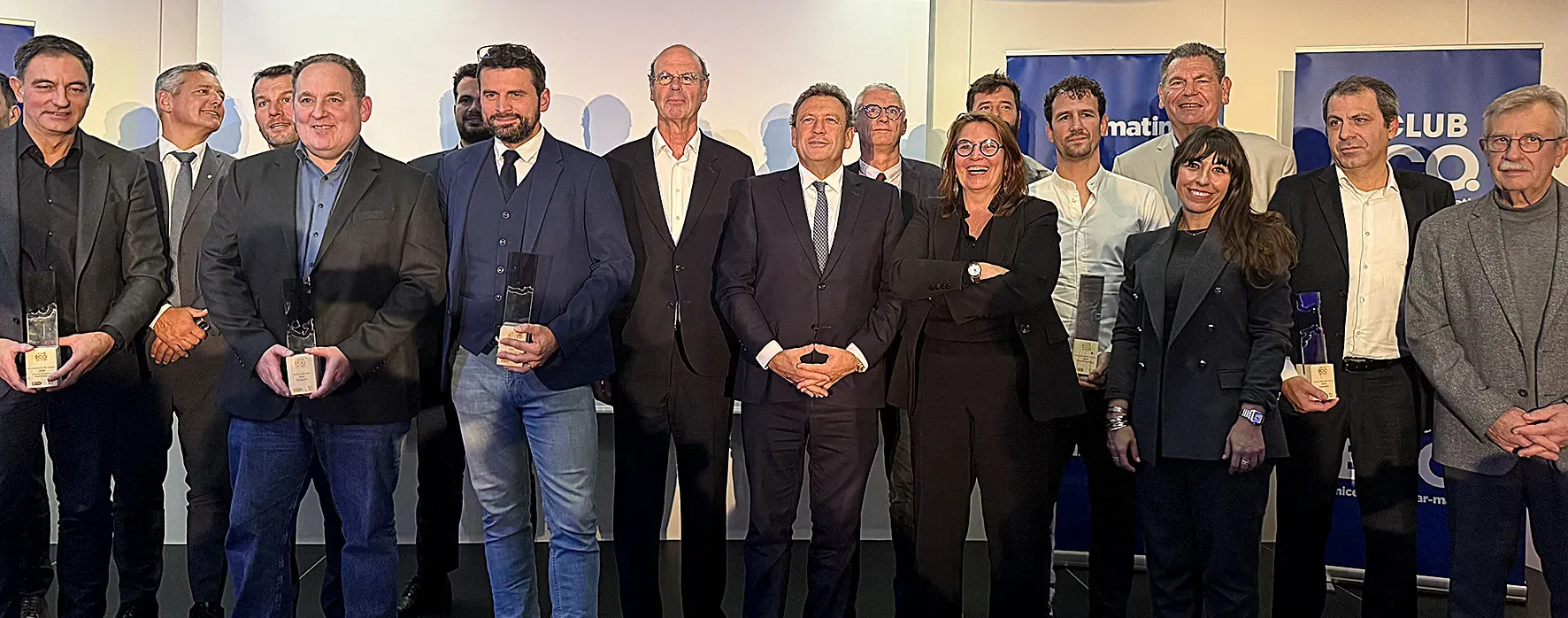
Clearly, this December 8, 2025, was not a preamble; it was a political and economic signal. The signal that the Région Sud and Var are not waiting for permission to enter the technological 21st century. This is what François de Canson asserts with confidence: 'The Région Sud and Var are entering through the front door, with the calm energy of those who know where they are going and the quiet determination of those who will not let themselves be overtaken.
La French Tech, in this momentum, plays an essential role. It connects, reveals, accelerates, federates, and enables entrepreneurs, SMEs, and startups to carry innovations that become benchmarks. We are talking, for example, about embedded artificial intelligence.
And while this expression may seem technical, it actually carries an immense imagination, a silent revolution: one where AI leaves laboratories, servers, and offices to become mobile, autonomous, embedded in systems, ships, drones, robots, weapons, and vehicles.' In short, an AI that acts, that dares, that assumes its place in reality, where risks, missions, and destinies are played out. An optimized, sober AI, because it must do more with less—it is, in its own way, a response to the digital ecological transition.

EXCELLENCE IS NOT A LUXURY The vice-president of the Région resumes: 'In Toulon, a city of the sea, defense, and innovation, where complex, vital, and demanding systems are designed and manufactured, where we cannot settle for decorative technologies. Here, when a technology fails, it is not a click that malfunctions; it is a mission, a ship, a border, a crew. Excellence is not a luxury.
Advertisement
It is a condition of national security. And that is why embedded AI finds its natural epicenter here, as if this land of sailors and engineers, used to facing the wind, salt, and the unpredictable, carried within it a vocation to tame complexity.'
Indeed, Var concentrates major players of the 21st-century economy: STMicroelectronics (Édouard Dulau), Naval Group (Sébastien Rousset), 21ème RIMA (colonel Delort), Université de Toulon (Xavier Leroux), l'ISEN Méditerranée (Agnès Laville), the teams of l'État (Isabelle Lebreton), and the study funded by the ANCT (presented by Céline Brunet) for the creation of a Centre International de l'IA Embarquée Maritime. This fabric of excellence also relies on SMEs, start-ups, and bold entrepreneurs who work in the shadows and invent the technological building blocks on which everything will depend tomorrow.
In charge of attractiveness at the Région, François de Canson knows it very well: 'They are the beating heart of our competitiveness. Few territories in France can align such an intensity of skills, research, industry, defense, and training. This is no accident.
It is capital. And in a world of fierce competition, capital must be transformed into power. Those who do not do so will be relegated to the periphery of history.
We are living in a time when history is accelerating, when nations are redefining themselves no longer just by their soil, their GDP, or their army, but by their ability to produce, master, and integrate technologies that give a decisive advantage. AI is at once an economic force, a strategic weapon, an accelerator of productivity, a vector of social transformation, an issue of European sovereignty, and, let us dare to say it, a revealer of political will. Those who move forward will be able to be powerful.
Those who hesitate will be dependent. And in this world that is reshuffling the cards, passivity is not an option.'
AN OFFENSIVE PLAN It is with this in mind that the president of the Région, Renaud Muselier, has committed the Région to an offensive plan with SUD IA, endowed with €70 million over five years, to put AI at the service of the population, make it accessible to everyone, and make the region a French leader. This plan is an act of trust, an act of protection, and an act of conquest. Its message is clear.
Technological progress must be a driver, and not a brake, to the development of the Région and its economy.
Advertisement
'And, we must seize them while there is still time, because tomorrow AI will represent hundreds of skilled jobs, difficult to relocate, which will sustain our businesses, our families, our territories. And this ambition can only be deployed if we meet the most essential challenge: human talent. Not only high-level engineers, but also technicians, operators, analysts, programmers, and maintenance workers.
Embedded AI will not depend solely on technology. It will depend on skills, training, pathways, vocations, and passions. It will depend on the human being, on their capacity to learn, to adapt, to understand what no machine will ever understand: nuance, doubt, meaning.
And, we must ensure that women find their full place in these jobs of the future. This requires a convergence between the Université, engineering schools, laboratories, industrialists, the armed forces, and public authorities.'
'If we want to be actors in the coming world, not its spectators, then let's go together, with audacity,' François de Canson concluded with optimism.
Photo CRT.