80 students successfully take up the Innovathon challenge
The Marine nationale's FANLAB organized the first 48-hour 'Innovathon' in Toulon with 80 students to innovate on data and drone challenges...
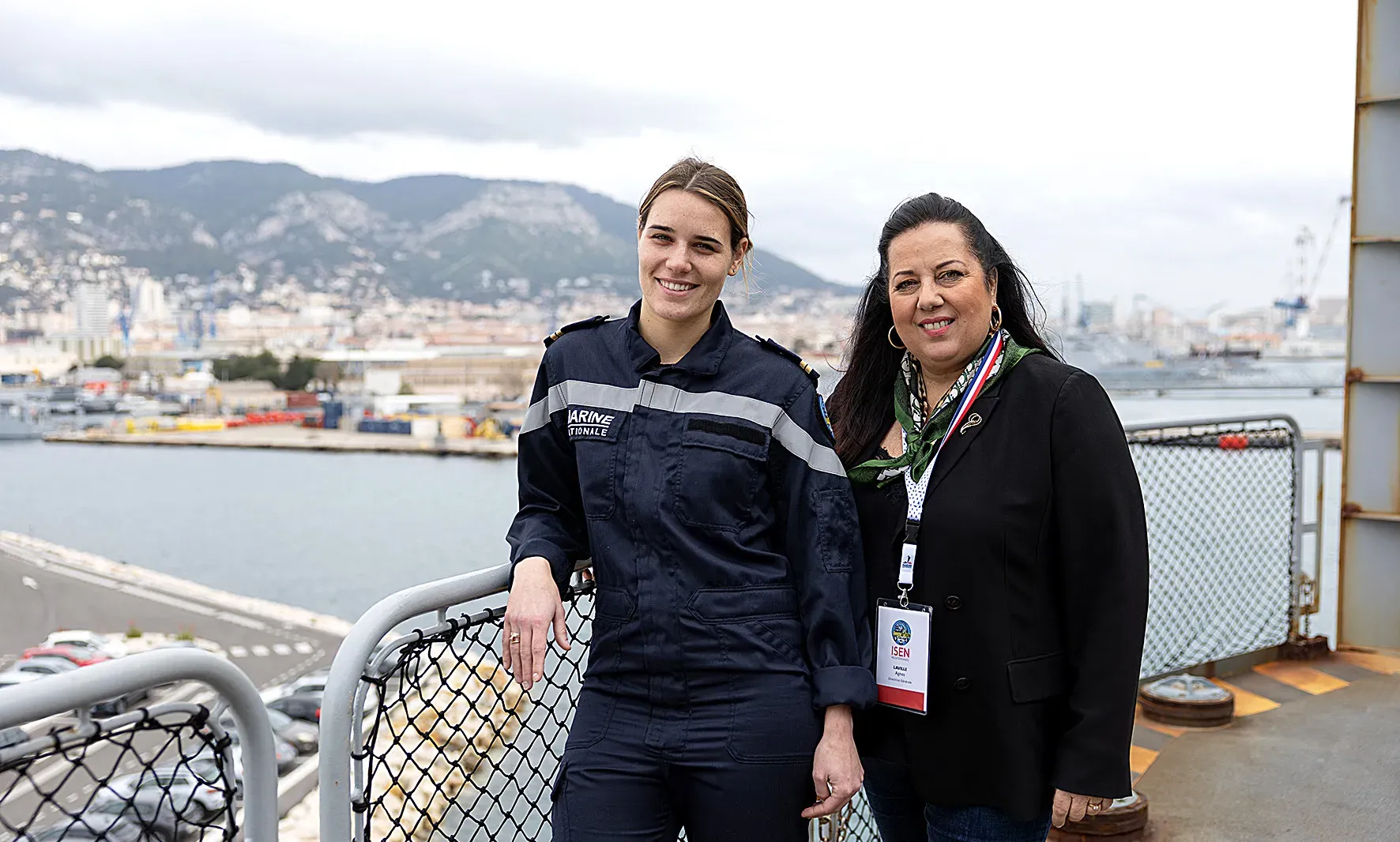
80 STUDENTS The FANLAB, the Marine nationale's Innovation Laboratory, is a development and research unit dedicated to improving the operational capabilities of vessels, particularly those of the Force d'Action Navale (FAN), and to simplifying the daily lives of sailors. Composed of around 25 people, mixing civilians and military personnel, including numerous apprentices and interns, the FANLAB team is organized around three main poles: digital (development, applications, IT, software, cybersecurity, AI, UX/UI), 3D (3D printing, modeling, simulator creation), and electromechanics (aerial, surface, and underwater drones, onboard systems, robotics). The head of the FANLAB, herself an ISEN alumna, took up her duties two years ago, backed by her engineering degree in cybersecurity.
The Innovathon, organized in collaboration with the PHA Mistral and ISEN in Toulon, marked the first edition of this 48-hour hackathon. The event brought together 80 fifth-year students from ISEN, who already possess a solid foundation of technical knowledge, alongside sailors from the FANLAB and other vessels, including the Mistral, onboard units, and land-based units. The objective was to "actually offer students problems coming from sailors so that they could think about them" for two days.

The head of the FANLAB highlighted the importance of this collaborative approach: "The big advantage for us is actually mobilizing external sources to get a fresh perspective on our issues. The initiative aimed to benefit from the contribution of people who do not yet have our constraints, who do not yet have knowledge of our military world, in order to generate innovative ideas and solutions." The central themes were data, drones, and artificial intelligence, crucial areas in today's naval context.
Advertisement
To support the participants, two conferences were organized: the first, the day before, on "design thinking," to understand how to gather a sailor's needs. The second, on the day of the pitch, on "the art of the pitch," to prepare the 5-minute presentations in front of a jury. This jury was composed of the second-in-command of the PHA Mistral, two representatives from ISEN, the digital transformation officer (Alfan ADT), and the head of the Centre de Services de la Donnée et de l'IA (CSD&AI Marine).
CONCRETE PROJECTS Among the projects developed, several concrete paths emerged: "Groups worked on drone-related solutions, acoustics, as well as data fusion and healthcare, particularly regarding the repatriation of the wounded aboard ships.
The idea of a "boat Waze," aiming to visualize and optimize in real time "In short, the Navy is not just an old lady, the Navy innovates, it evolves, and is fully into innovation as much as one can be in the civilian world." navigation conditions and routes, was also explored. A topic also focused on measuring fatigue and psychosocial risks (RPS), a theme that is the subject of an external development project at CEPN.


Participants were encouraged to freely express their creativity, without being held back, in order to ensure the originality of the proposals."
SPRINGBOARD FOR RECRUITMENT At the end of the Innovathon, each team presented a "Proof of Concept" (POC). The FANLAB then takes charge of "recovering the projects, so depending of course on their relevance and usefulness, they enter our workload and then we follow, we continue to follow the projects."

The event also constitutes a lever for recruitment, strengthening the "arms-nation link."
Photos Philippe OLIVIER.
Photos Philippe OLIVIER.