The volunteers' journey revealed through immersion
While its future officers sail across the globe, the Marine nationale prepares the next generation at the dock.
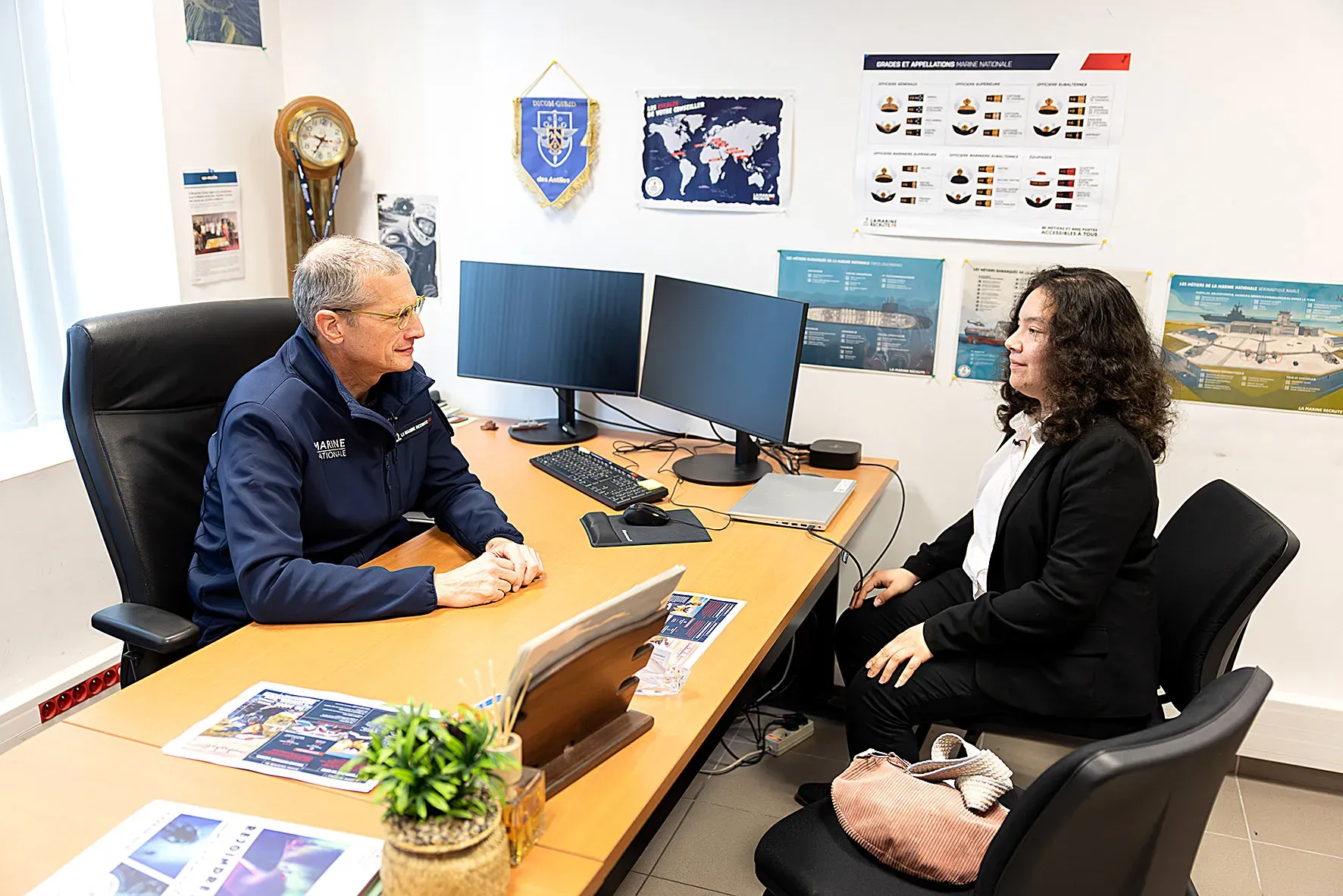
It launched a recruitment campaign for its service national volontaire (SNV), a 10-month commitment intended for young people aged 18 to 25. In Toulon, which accounts for 10% of the national workforce, around twenty applications have already been recorded in one month, out of a target of 600 volunteers in France by the summer. The Marine presented the journey of the service national volunteers, from recruitment to operational employment, during a dedicated day. This is a major communication campaign that the ministère des Armées et des Anciens combattants orchestrated in the Var. Six months before the enlistment of the next volunteers, the Marine nationale opened its doors for a day of total immersion, on February 19. This program offers an immersion into Marine professions across three major fields: support to the forces (administration, catering), protection (fusiliers marins, drone piloting), and coastal defense (mechanics, monitoring in semaphores). The objective allowed for discovering, from the inside, the entire journey offered to young recruits, from their first contact with the institution to their deployment within the units. Between Toulon and Saint-Mandrier-sur-Mer, this journey highlighted the realities of the service national Marine, a system that combines military training, technical learning, and human experience. "We are not going to send them on missions or to conflict zones," stressed maître principal Sébastien, an advisor at the Centre d'Information et de Recrutement des Forces Armées (CIRFA) of Toulon. The initial one-month training includes sports activities and learning military fundamentals, from shooting to marching. Volunteers receive an allowance of €800 per month and benefit from 21 days of leave. Recruitment continues until July for a planned enlistment in the coming September and October.
ENTRY POINT OF THE CIRFA

The day began where everything starts for future sailors: at the Centre d'information et de recrutement des forces armées (CIRFA) Marine of Toulon, located on boulevard Commandant-Nicolas. It is within this structure that the first decisive step of commitment takes place. The CIRFA teams detailed the rigorous process that awaits each candidate wishing to join the ranks. This segment allowed for deciphering the different phases of recruitment: the initial reception, the verification of selection criteria, motivation interviews, and personalized support towards commitment. For the Marine nationale, the goal is to demonstrate that integration is a structured process, where each applicant is guided to find the path that best corresponds to their profile and the needs of the institution. The immersion continued at the heart of the action at the Base navale de Toulon and the Pôle Ecoles Méditerranée. This is where the concept of operational employment takes on its full meaning. Far from clichés, the Marine highlighted the extraordinary variety of careers accessible through the service national. In contact with sailors stationed within operational units, the participants measured the scope of possibilities. The service national Marine is not limited to a single function. It opens the door to nearly 80 different professions. From technical specialties to protection roles, the range is wide. These exchanges helped materialize the prospects offered to volunteers, proving that this service national is a true professional stepping stone.
TRAINING REQUIREMENTS

The final part of this day took place in Saint-Mandrier-sur-Mer, within the Pôle Ecoles Méditerranée, the crucible of sailor training. This is where recruits acquire the fundamentals of military life and the technical skills necessary for their future assignment. This sequence offered a dive into the daily life of the students, structured by dense and demanding instruction. The program covered the pillars of volunteer preparation. First, maritime instruction with the learning of navigation rules and crew life, then firearms training with the mastery of individual weaponry, and combat techniques with preparation for operational situations and the physical preparation essential for the ruggedness and endurance of the sailor.
Among the professions presented, several specialties were highlighted: Manœuvrier: at the heart of the nautical operation of vessels. Mécanicien: guarantor of onboard propulsion and energy. Fusilier marin: key player in the protection and defense of sites and vessels. Patron d'embarcation: responsible for the navigation of light craft.


Photos by Philippe OLIVIER.