Pierre Béloni: "A third album is already rumbling under the surface"
In the midst of creating his third album, Pierre Béloni moves forward with the precision of a craftsman and the eye of a reporter.
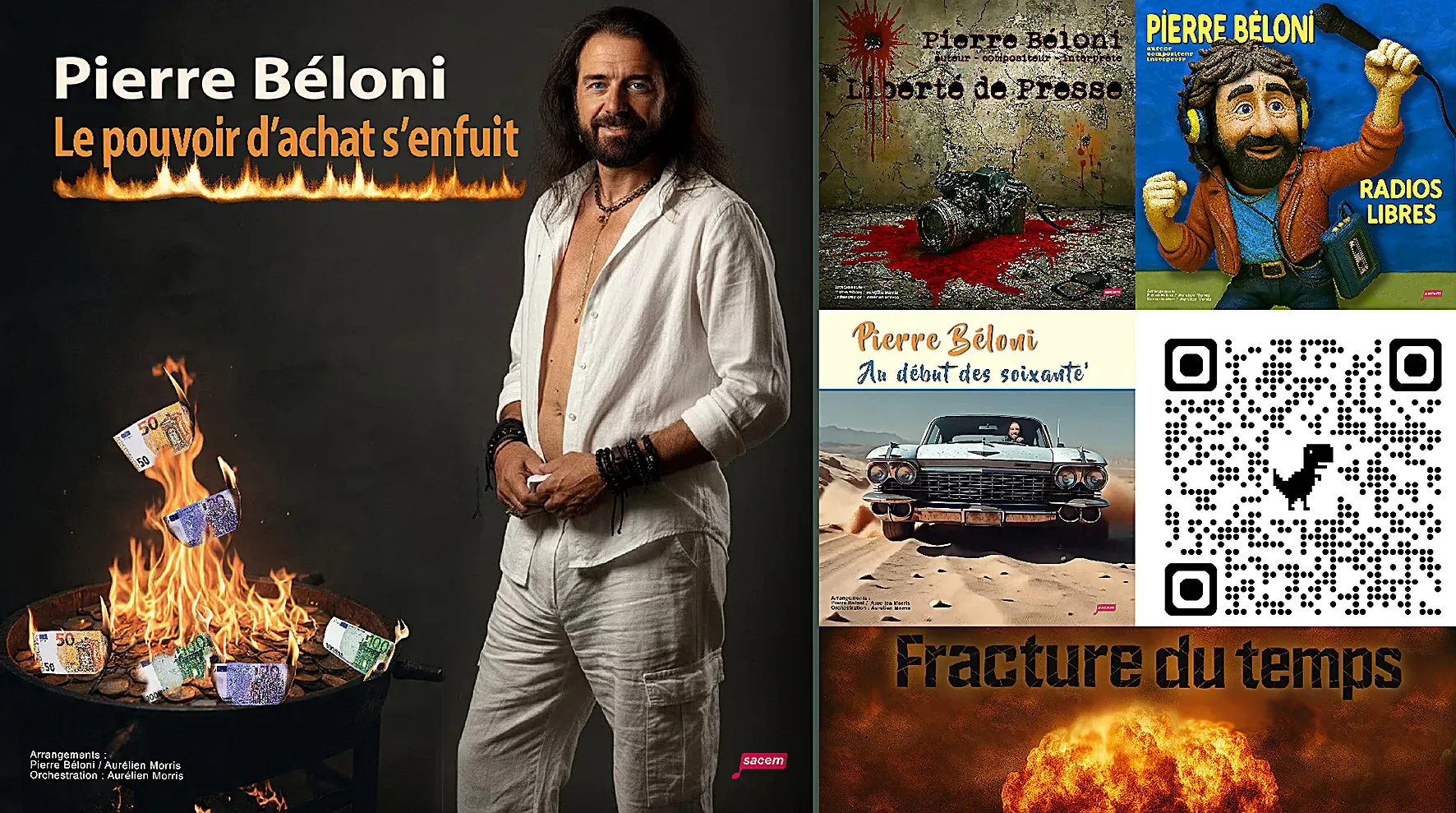
The Toulon singer-songwriter is crafting a project scheduled for release around mid-year: a record that scrutinizes the times, captures its tremors, and transforms reality into sensitive material.
He moves forward without rushing, but never stands back. He is one of those artists who do not seek the spotlight: they reignite it when it goes out.
A Toulon singer-songwriter-performer, he made an impression with "Toulon de mon enfance" (album "C'est la vie", 2025). For him, a song is carved like a rough stone: with a hammer, patience, and that craftsman's precision inherited from his years in journalism.

His third album could be called "Action – réaction" or "Réactions en chaîne". Nothing is set in stone, but the direction is clear: "it's going to shake things up, connect, and awaken."
Advertisement
5 TRACKS ALREADY REVEALED Out of the twelve planned tracks, seven are already composed. Five have been released on streaming platforms, with no announcement, no strategy. A way of gauging the times just as a reporter plants his microphone in the street. These five tracks form a compact block, a musical mini-reportage on our daily lives.
"Fracture du temps" opens the show: a cold warning, a world teetering. "Liberté de presse" pays tribute to those who have been silenced. "Radios libres" reactivates the spirit of the 80s, when people spoke outside the box, outside the rules, outside of fear.
"Au début des 60" reactivates a still-living heritage, one that continues to shape our present and our future. And "Le pouvoir d'achat s'enfuit", with its 2000s-style boy band music video, has surpassed 30,000 streams: a tight groove that tells of end-of-the-month acrobatics, in which he had already pointed out rising prices long before they exploded. A lucidity that resonates today as a visionary intuition.
Two other tracks are in the studio: "Addiction numérique" explores the grip of mobile phones and social networks, and "Le destin des parents", a hard-hitting chronicle of modern abandonment, of parents who were once welcomed into their children's homes, today, voluntarily, isolated in specialized institutions. Fear, memory, resistance, generational divide, getting by: he writes the way one keeps a field notebook: "I tell what I see. Songs are my way of giving meaning to life."
AN ALBUM THAT SHAKES THINGS UP For him, nothing is left to chance. Each song is thought of as a complete project, a small universe where music, text, and image move forward together: "I never separate music from video. A song is a world.
I see it before I hear it." This approach results in an album that crosses eras and genres: metal rock, blues, film scores, 80s sounds, echoes of the 2000s.
A broad, assumed palette that allows him to tell of reality from several angles: "Each song must find its form. I refuse the easy way out."
The journalist has never put away his notebook. The director has never turned off his camera. A former reporter and JRI, he has never left the field. He has simply transformed it.
His songs resemble scenes captured live, moments that we refuse to let disappear. He does not dramatize. He does not simplify. He observes: "Journalism taught me to look before writing. Today, I add emotion."
Advertisement
Album after album, a solid coherence emerges: memory, freedom, truth. His work blends documentary, poetry, and song, on the border of testimony and visual art. An identifiable, unique, and assumed signature: a committed, plural, nervous, sensory French song, which resembles nothing but itself and has not finished shaking things up.
Like his two previous albums, this third opus is released in a double format: a 28-page paper booklet version, with or without the audio CD, and a digital version available on streaming platforms.