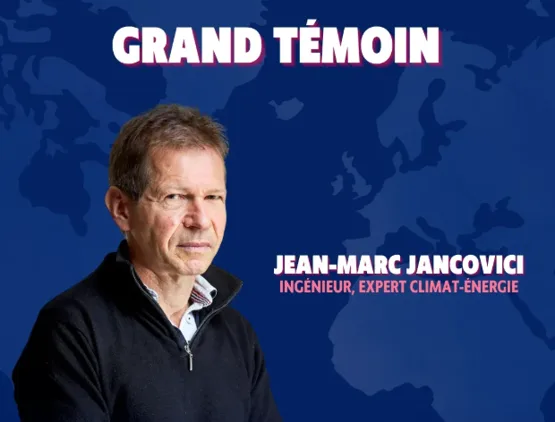
Jean-Marc Jancovici, Key Witness at the Rencontres Stratégiques de la Méditerranée
The RSMed 2026 in Toulon will host Jean-Marc Jancovici, focusing on the Indo-Pacific and the Middle East.
Organized by the Institut FMES, the Rencontres Stratégiques de la Méditerranée (RSMed) have established themselves since their creation in 2022 as the benchmark geopolitical event in France.
For its new edition, on October 7 and 8, 2026, at the Palais Neptune in Toulon, the event has unveiled two of its fifteen round tables, promising highly topical debates on major global balances.
The 2026 edition welcomes a leading figure in Jean-Marc Jancovici. Engineer, teacher, lecturer, and president of the think tank The Shift Project, he is one of the most listened-to voices on energy, climate, and low-carbon transition issues.
Advertisement
His speech as key witness will shed essential light on the systemic challenges facing contemporary societies and states.
The Indo-Pacific, theater of US-China competition
A first round table will focus on the Indo-Pacific, one of the main theaters in the reshaping of the global order. The analysis will go beyond the simple prism of rivalry between China and the United States to explore the complex dynamics of this region.
The debates will highlight the growing role of a plurality of regional actors, such as India, Japan, Indonesia, South Korea, Australia, and Vietnam. Long perceived as secondary powers, they are now asserting themselves as structuring actors.
Their strategies, based on diversifying partnerships, strengthening their economic and military capabilities, and forming flexible coalitions, allow them to maximize their room for maneuver. The unique role of ASEAN, as a multilateral framework, will be at the heart of the discussions to understand the reconfiguration of spheres of influence in the region.
War and strategic reshaping in the Middle East
The second theme will address strategic reshaping in the Middle East through a forecasting exercise. The round table will explore the consequences of a hypothetical war launched in February 2026 by the United States and Israel against Iran.
This scenario will be analyzed at the intersection of global rivalries involving Washington, Beijing, and Moscow, and regional tensions between Iran, Israel, Saudi Arabia, and Turkey.
This geopolitical simulation will examine the repercussions of such a conflict on neighboring countries like Lebanon, Iraq, or Jordan, as well as the impact of a potential blockade of the Strait of Hormuz on global energy security.
A free event open to all
Each year, the RSMed brings together more than 3,500 participants – students, defense industrialists, military personnel, diplomats, elected officials, journalists, and academics.
Advertisement
The event features more than 16 round tables hosted by over 80 experts, combining operational, academic, and technological perspectives to decipher major geopolitical challenges.
It is free and open to the public, but registration is mandatory due to the limited number of places.

Article from the print edition of La Gazette du Var