In the historical footsteps of Château Carqueiranne
René Ghiglione and Roger Reineri, passionate historian and geographer, reveal the past of Château Carqueiranne.
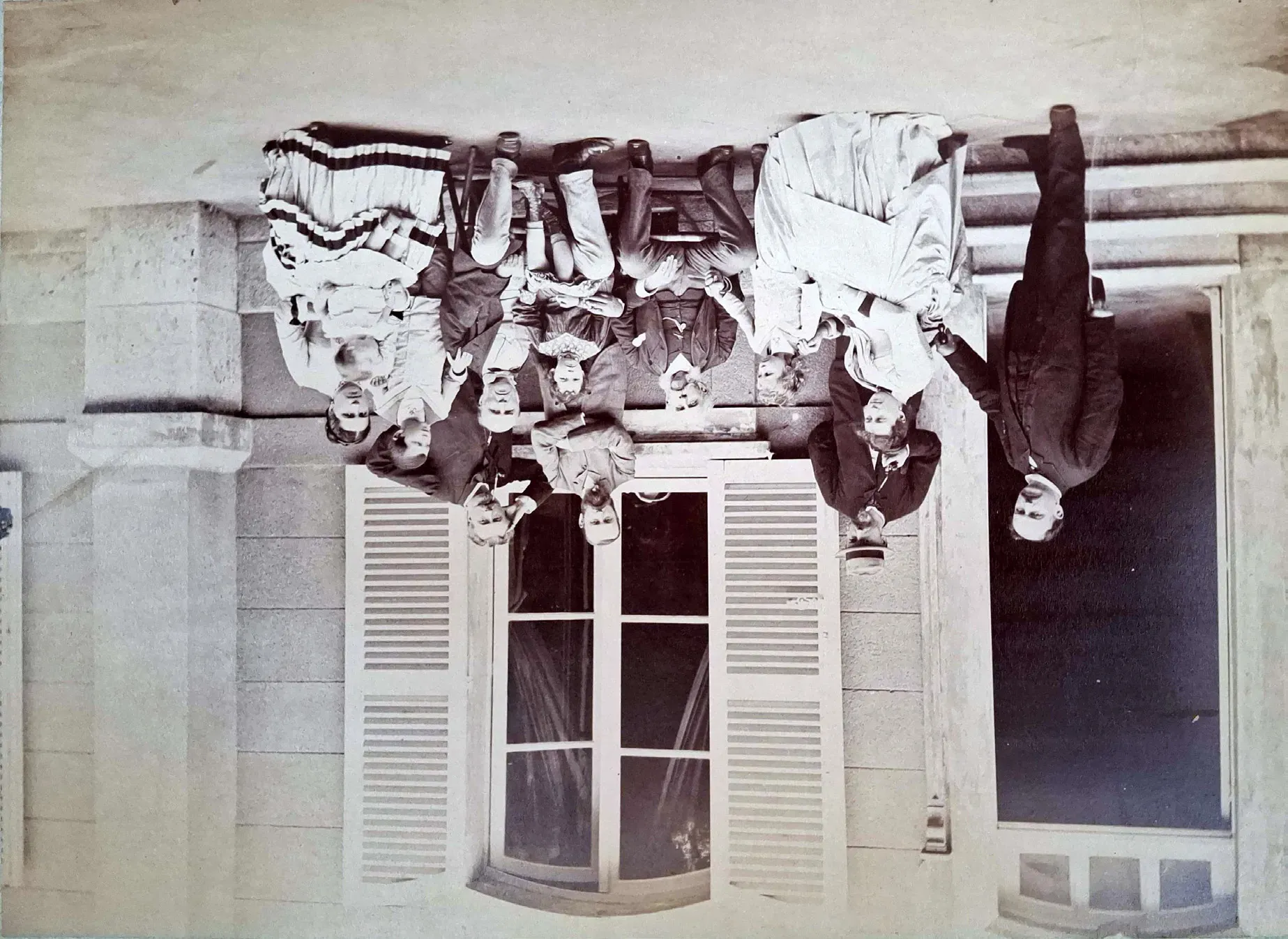
In Carqueiranne, Vincent Lamour was far from thinking that the house acquired by Alfred Richet in 1873 had an older history. Indeed, in the past, Château Richet was called Château Carqueiranne. The name existed long before the Appellations d’Origine Protégée! The research work of Roger Reineri, a Carqueiranne resident and geographer by training, has shed light on some obscure points regarding the history of the castle before the acquisition of this property by the Richet family. Thus, the term Château Carqueiranne appears on the so-called Cassini maps dating from the 18th century.
AN INCREDIBLE HISTORY

While giving a new lease of life to the castle by restoring it identically, Vincent Lamour dwells on its past: "The construction phases remain a bit unclear. This estate, over the years, since Guillaume de Carcarana in 1217, grew significantly with more than 250 hectares of agricultural land the acquisition of Château and wine-growing. I imagine there were two construction phases of the bastide, which gradually became a castle, notably because the back cellar is smaller than the castle today. This place is loaded with various stories; it constitutes an incredible historical palette." Seven owners have already been identified between the 17th century and the acquisition of a 230-hectare estate by the Richet family in 1873. The owner adds: "History reveals a property link between the estate and the very ancient family of La Garde (the Thomas), a family that produced knights who participated in the crusades! The existence of the trefoil cross with a pointed foot on the battlements and on the terracotta tiles at the top of the castle confirms the presence of the Thomas de La Garde and the Marc-Tripoli de Panisse - Passis. An interesting element, also to be highlighted, is the religious dimension of the estate. A chapel, probably dating from the 18th century, is currently being restored. It is proven that the Bishop of Toulon, Louis de la Tour du Pin de Montauban, died at the castle on September 12, 1737. With a first certainty, at this date, the castle was already built."

MEDIUM AND NOBEL PRIZE
Extraordinary characters have passed through this castle, counts, countesses, an English lord and, notably, the Richet family. It was in 1873 that Alfred Richet acquired the castle. "René Ghiglione had collected a lot of information on this subject. Everything was already built, but exterior and probably interior landscaping work was undertaken. A hydraulic project was launched with a dam, aqueducts, and reservoirs. It was during the construction of the Colle Noire dam that Alfred Richet's wife, Eugénie Renouard, daughter of Charles Renouard (inventor of copyright), died when the dam collapsed on June 7, 1884. It was a national mourning," recalls Vincent Lamour. The year 1894 was marked by the beginning of spiritualism experiments in the presence of the medium Eusapia Palladino. Charles Richet brought great mediums, Nobel Prize winners, and other scientists to Château Carqueiranne and to the island of Grand Ribaud, which he had bought, to verify the truth of these experiments. He was the inventor of Metapsychics and, in 1895, of the term "Ectoplasm" (luminous apparition), dear to Hergé's Captain Haddock. It is thanks to Charles Richet that Carqueiranne is part of the global aeronautical epic. Indeed, Charles Richet and Victor Tatin built, at the back of the castle, in a vast Eiffel hangar, the first steam aeroplanes in 1896 and 1897. A stele, located at pointe Peno, is erected and recalls the first trials: "Here was launched in May 1896 and June 1897, a first aeroplane by Charles Richet and Victor Tatin, in the presence of Albert Richet, then an aviator officer, who died for France in the battle of Anizyle-Château, August 29, 1918." Charles Richet also financed the beginnings of the Louis Breguet company. Obviously, the medical student, who lived between Paris and the Château de Carqueiranne, was a great associate professor of physiology, Nobel Prize in Medicine in 1913 for his work on anaphylaxis, but also a writer, author of plays performed by Sarah Bernhardt and of poetry. From Henri de Thomas to Vincent Lamour, history continues! There are still leads to explore, but each step allows us to discover the pieces of a historical puzzle that still holds beautiful surprises for us in the coming months!"

Laurette PARAY - Photos by Jean RICHET.