The City combats urban heat islands
In the city, the urban transformation takes root in a global and sustainable vision.
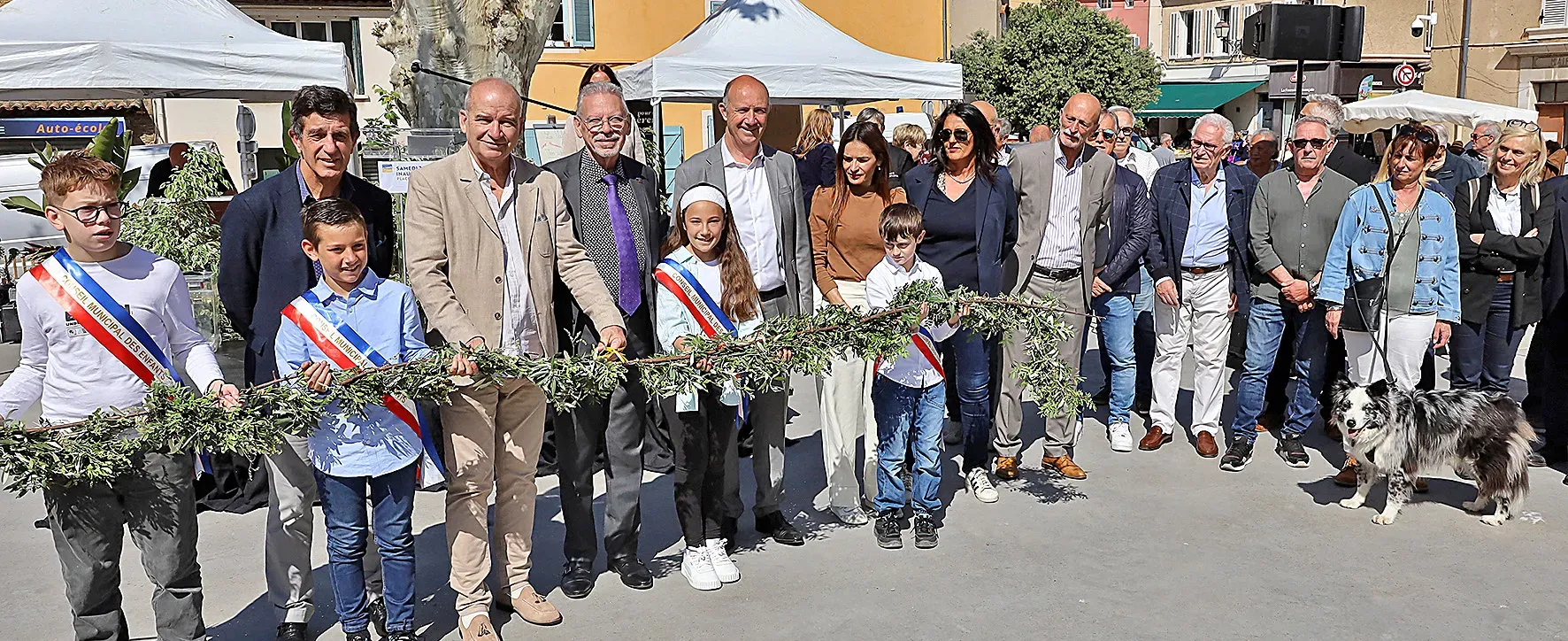
After rebuilding the downtown schools, the Municipalité is also rethinking public spaces and integrating them into a broader greening project. It has made the redevelopment of place Général de Gaulle a concrete example of the fight against heat islands and adaptation to climate challenges.
EXEMPLARY DEVELOPMENT

During the inauguration of the square on April 26, Thierry Albertini, the mayor, welcomed the achievement: "Despite the technical challenges and the need to preserve the integrity of the underground car park by avoiding any overloading, and to maintain an open space for events, this redevelopment has delivered an exemplary layout, both aesthetically and environmentally. The intervention respected the existing plant framework with the preservation and regular monitoring of the plane and hackberry trees lining the square. These natural elements thrive in a redesigned setting, echoing the architecture of the mairie and the more contemporary buildings around it. It is a symbolic link between two urban eras, but also a strong gesture in favor of a more resilient city." Since its creation in the 1980s, the square had been an exclusively mineral and concrete public space, beneath which lie the two levels of one of the city's two free public car parks. In 2023, in order to combat global warming and after having completed the redevelopment and greening of place Jean-Moulin, the Ville and the Métropole Toulon Méditerranée decided to carry out a second greening project by transforming place de Gaulle.

FROM NOW ON, VEGETATION DOMINATES

This project has several goals. First, to avoid a heat island in the town center. Second, to offer a pleasant experience to walkers and users of the multiple services surrounding the square (espace pédagogique Jean d’Ormesson, salle polyvalente Valérie Garnier, mairie, medical practices, Archives municipales, bank, Poste, shops, and restaurants). Finally, to reinforce the coherence between the various landscaped areas of the city, with a selection of Mediterranean species adapted to climatic constraints. The bet has paid off! Indeed, greenery now dominates the site thanks to plants established on both sides of the square. In the northern part, in addition to the large existing hackberry trees, 9 citrus trees (lemon trees) have been planted to create a colorful foreground. To the south, 3 jacarandas, 3 Judas trees, and 3 false pepper trees of at least 3.5 meters recreate a green facade on the existing building of the Médiéval. To the west, the natural soil has been uncovered and hosts exotic plantings. This part becomes permeable to rainwater and creates a new green facade for the square. Furthermore, the entire square benefited from hydro-blasting, giving a new look to the existing ground, complemented by the replacement of the stones representing the grid pattern of the square. To complete the shade, 5 custom-made pergolas have been installed, whose perforated sheet metal roofs mimic the shape of olive leaves. At night, the roof patterns are cast onto the ground using spotlights suspended from the structure. Each structure houses a bench and two armchairs, whose seats and backrests also feature a plant motif. A glittering, curving pathway breaks up the grid layout of the site while connecting the different areas of the public space. Finally, all the peripheral lighting has been replaced, allowing for nocturnal projections of plant motifs. Paintings are thus projected onto the white facade to the south, and violets onto the ground, in memory of the town's horticultural past. •

In the presence of: Jean-Louis MASSON, president of the Département, Ange MUSSO, mayor of the town of Revestles-Eaux.
Photos PRESSE AGENCE.