Stroke, recognize the warning signs!
On October 29 at Sainte Musse hospital, for World Stroke Day, many specialists answered questions about...
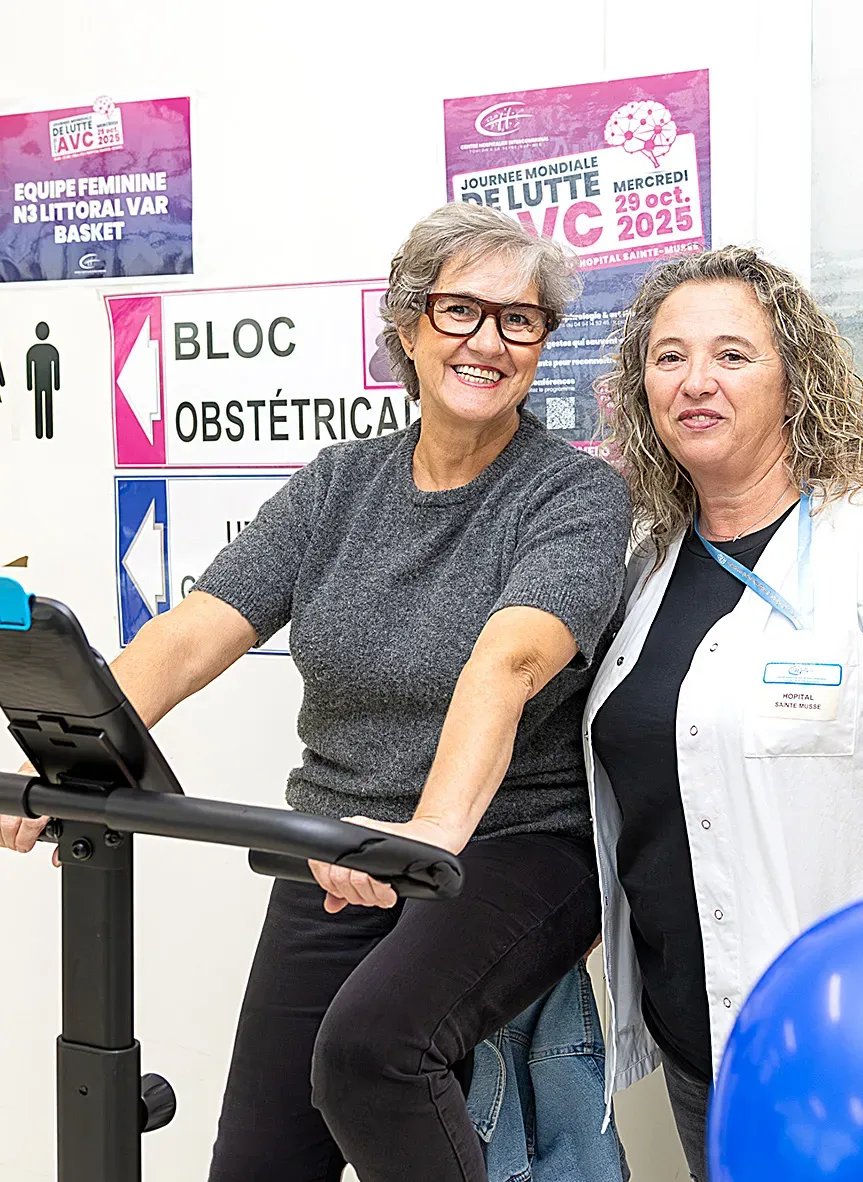
Risk factors, warning signs, treatments, prevention, life after a stroke, unlike myocardial infarction, there is generally no pain during a stroke. "Whatever the type (ischemic or hemorrhagic), the symptoms are identical because they only depend on the malfunctioning brain area," explained the health professionals present (neurologists, physiotherapists, speech therapists, tobacco specialist, and partners) at length.
150,000 PEOPLE VICTIMS OF A STROKE In France, nearly 150,000 people are victims every year. It is the leading cause of acquired adult disability, the second leading cause of dementia after Alzheimer's disease, and the third leading cause of mortality after myocardial infarction and cancers.
"The objective was to raise public awareness about the warning signs of stroke, which occur suddenly and unexpectedly (facial asymmetry, weakness in an arm, a leg or an entire side of the body, loss of sensation or numbness in an arm, a leg or an entire side of the body, speech difficulties, decreased vision...)," says the hospital.
Indeed, knowing the warning signs makes it possible to remember to call emergency services when one or more symptoms appear, to enter the proposed "neurovascular pathway" to recognize the signs of a stroke, with life-saving action initiations with UDSP 83, sophrology workshops, and art therapy.

En France, près de 150 000 personnes en sont victimes chaque année. C'est la première cause de handicap acquis de l’adulte, la deuxième cause de démence après la maladie d’Alzheimer et la troisième cause de mortalité après l’infarctus du myocarde et les cancers. « L'objectif était de sensibiliser le grand public sur les signes d'alerte des AVC qui surviennent de façon soudaine et inattendue (asymétrie du visage, baisse de force d’un bras, d’une jambe ou de tout un côté du corps, baisse de sensation ou engourdissement d’un bras, d’une jambe ou de tout un côté du corps, trouble de la parole, baisse de la vision...) », indique l'hôpital. En effet, la connaissance des signes d'alerte permet de penser à appeler les secours à l’apparition d'un ou plusieurs des symptômes, pour entrer dans la « filière neuro vasculaire » et déclencher une prise en charge la plus rapide possible pour limiter au maximum un éventuel AVC et ses conséquences. Dès l’apparition d’un ou plusieurs de ces symptômes, il s’agit d’une urgence vitale. Il est donc très important d’appeler le 15 ou le 112. Enfin, un espace dédié aux enfants était aussi proposée pour reconnaître les signes de l’AVC, avec des initiations aux gestes qui sauvent avec l’UDSP 83, des ateliers de sophrologie et de l’art thérapie. Un défi vélo était également présenté par l’équipe nationale Féminine 3 de Littoral Var Basket. •

A cycling challenge was also presented by the national Women's 3 team of Littoral Var Basket, aiming to trigger the fastest possible care to minimize as much as possible a potential stroke and its consequences.
Advertisement
As soon as one or more of these symptoms appear, it is a medical emergency. It is therefore very important to call 15 or 112.

Finally, a space dedicated to children was also PLEASE NOTE...

2 main reasons cause strokes: The occlusion of an artery by a blood clot is an ischemic stroke, also called a cerebral infarction. The rupture of a blood vessel inside the brain causing a hemorrhage is a hemorrhagic stroke. A hematoma forms and compresses the affected brain area.
Depending on the affected brain area, the person suddenly presents one or several symptoms: Tingling or loss of sensation or paralysis on one side (left or right) of the body (face, arm, leg), Vision disorders (reduction of the visual field, loss of vision in 1 eye, double vision), Balance problems when walking (sudden feeling of drunkenness), Difficulties speaking (articulating, finding words, or.

Photos Philippe OLIVIER.