A new strategy to optimize blood and plasma donation
La Valette-du-Var and the EFS partner through an agreement to optimize the local blood and plasma collection strategy.
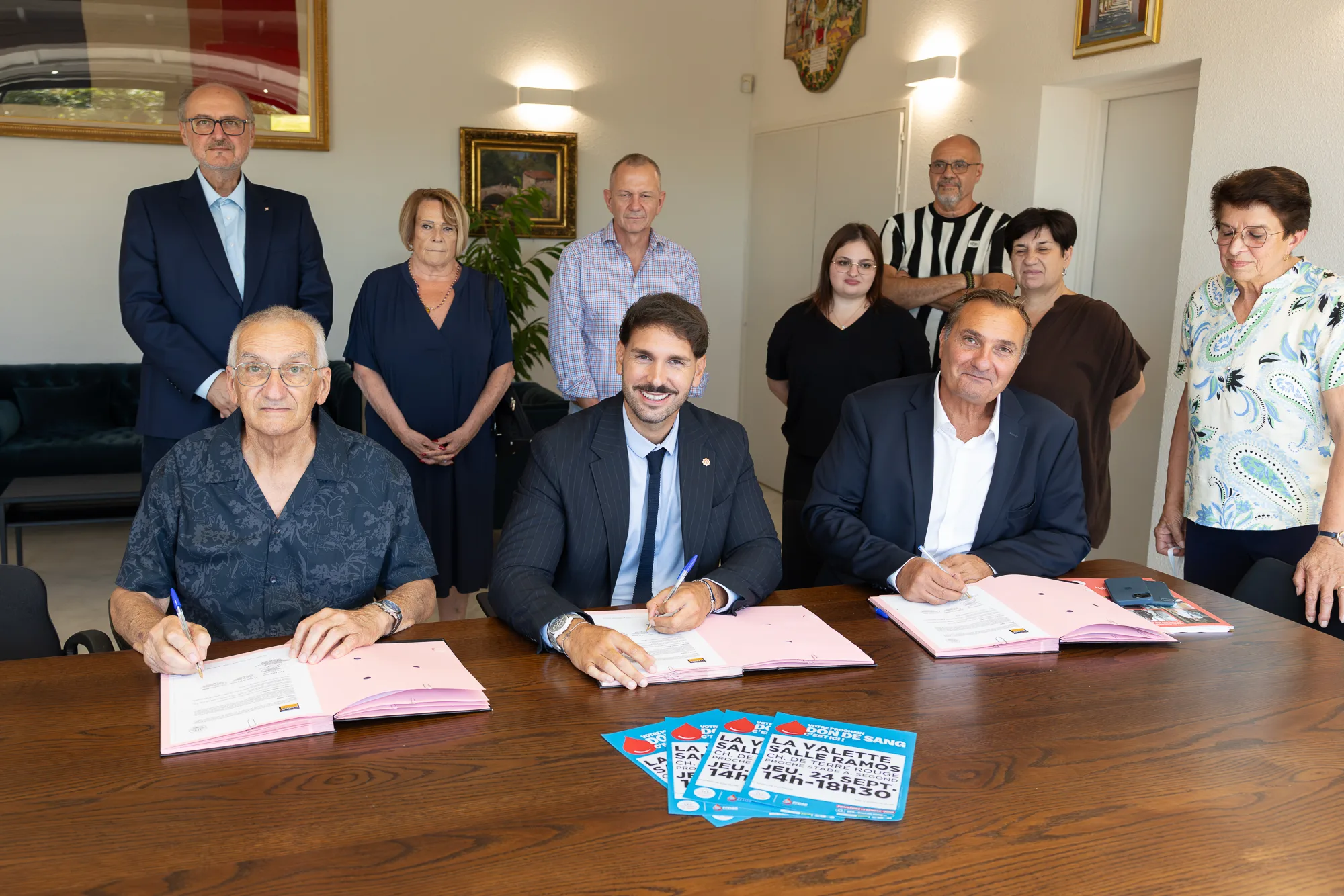
The Ville de La Valette-du-Var and the Établissement Français du Sang (EFS) have officialized the signing of an agreement intended to thoroughly rethink the blood product collection strategy in the territory.
This partnership, led by Mayor Julien Argento and Alexandre Talamoni, representative of the EFS, aims for a finer and more efficient management of donations to meet the vital needs of nearly 1,500,000 patients who benefit from them each year in France.
The new approach is built around a better orientation of donors towards the most necessary types of donations. Plasma, for example, which is essential for the manufacture of many medicines, requires specific equipment available only at fixed sites.
Advertisement
To do this, the EFS intends to strengthen the attractiveness of its permanent donation centers, such as the one at the Sainte-Musse hospital in Toulon, by increasing its welcoming time slots.
The number of mobile collections will be decreased, without reducing the overall volume of donations. They will be reorganized to be more targeted and to guarantee better participation.
A civic and solidary act
"This reorganization will make it possible to redeploy human and material resources towards the most technical collections. This will also allow us to assign resources to our Sainte-Musse site at the EFS to increase plasma collections. So it is a logic of efficiency, certainly, but also of good management of public money, always in the primary interest of the patient," explained Alexandre Talamoni.
Julien Argento, mayor of La Valette-du-Var, recalled the strong civic and solidary dimension of blood donation. He launched an appeal to other actors in the territory, local authorities or businesses, to encourage this gesture by granting time to their agents and employees: "Spreading the word means that it is also brought to the attention of other local authorities [...] regarding the possibility [...] of releasing agents, it can be 2 hours, 3 hours, but so that they have the time to go and give their blood donation."
For the elected official, this act of generosity is a powerful marker of social cohesion: "These are small everyday gestures that can reassure us that benevolence, real and concrete solidarity still exist in an era which unfortunately tends to forget it far too often."
A collective challenge
Blood donation constitutes a chain of solidarity relying on the commitment of everyone: donors, association volunteers, healthcare staff, and institutional partners.
Alexandre Talamoni recalled the universal and unpredictable nature of the need: "These patients are children, adults, elderly people. We are not immune to illness, we are not immune to accidents, it can happen to all of us."
An appeal was launched to attract new volunteers, particularly among the youngest, in order to renew the active forces of blood donor associations and ensure the sustainability of this cause, which is essential to public health.

Photos Philippe OLIVIER.